
Daring to Be Optimistic: A New Middle East Diplomacy in Prospect
The Raspberry Patch #105: A Levantine Leap

Today’s Raspberry Patch essay is not about U.S. politics, at least not directly. It is not about The Age of Spectacle either, the bread-and-butter of this Substack. It is not much about the general and particular impact of the Trump 2.0 Administration’s mis-administering of almost everything—the core topic of TRP’s “Post-January 20 AoS Chronicle” series, now standing at thirty essays. That mis-administration certainly includes foreign and national security policy, and the multi-purpose tool of U.S. diplomacy with it; but here we touch on that only at the margin. So this is not a typical TRP essay compared to most that have been offered up during the past year. Instead it links back to matters Middle Eastern, specifically Levantine.
The most recent time I did this sort of thing in this space was seven months ago with “Mullah, Mullah, You’d Better Stall, Says the Dumbest One of All”: Post-January 20 AoS Chronicle, No. 8, on April 18, 2025. Outside TRP I also wrote this, because the mullahs ignored my advice and so did not stall: “The Twelve Day War: Truths and Consequences,” Quillette, July 5, 2025. Before that we have to go back more than eleven months to “A Bold Plan for Syria….that will never happen,” on December 8, 2024 (cross-posted to Cosmopolitan Globalist, December 23, 2024). And before that we need go back, 101 mostly long-form essays ago, all the way to “Lebanon Agonistes” on January 14, 2024, the fourth post of TRP, which debuted on January 4, 2024.
Tempting as it is, I’m not going to quote myself from these old essays, so no worries. (They’re in the TRP archives for review if you’re curious about them.) I plan to do much worse than that: I’m going to review some email conversations I’ve had in recent days about the unprecedented state visit of Syrian President Ahmad ash-Shara’a to Washington, and matters related thereto. I’m doing this for two reasons: to illustrate what conversations among experienced experts in granular foreign policy/national security topics sound like, for readers who might find that educational; and to use the conversations, paraphrased rather than repeated verbatim, to expand some on hopefully useful background on the topic, presented first just below….
But two things before we get down to business. First, I fixed some errors in last week’s essay “Sayeth the Tombstones”—a few typos and one brainfart. These errors did not affect the gist, insofar as there was one in that relatively “lite” essay.
Second, I know I mentioned a few posts back that my essay “Entwinings: Literature and History, Fathers and Sons, Writers and Readers,” The Hedgehog Review (Fall 2025) had been published online. But only this past Thursday did I receive hard copies of the issue in the mail. The PDF I had received neglected to include the issue’s table of contents, so between getting it and receiving the hard copy I knew not in whose company I sat. That matters to me as a still unreconstructed thought magazine editor, for the curation of an issue is an art apart from the contents of individual essays, reviews, and comments cohabiting a particular issue.
So come to find out that, at the least, I am in some fine company already known to me: Tara Isabella Burton, whom I do not know personally but whose writings I have read and some of them have cited in The Age of Spectacle manuscript; and Richard Thompson Ford, one of my favorite American Interest authors of all time, and certainly one of the shrewdest observers of American culture out there—as his short essay “Cosplay” in the Fall 2025 Hedgehog Review demonstrates. Good for me, good for Hedgehog Review publisher James Davison Hunter, and good for editor Jay Tolson.
Bilad ash-Sham (بِلَاد الشَّام ) and Le Grand Liban (لبنان الكبير)
Syrian President Ahmed ash-Shara’a visited Washington and met with the American President this past week. President Shara’a also met members of the press and other U.S. officials before heading back to Damascus. And “so what?”, oh, about 98%-plus percent of adult Americans would ask, if they even know about the visit. Well here is just a bit of “so what” if you, dear reader, happen to be among those 98%-plus, which let me stress immediately is nothing to be ashamed of or to get tempest-tossed about. We’re all busy….and no small number of readers are a bit rattled these days, too much so perhaps to pay attention to a visiting foreigner.
For our first “so what,” just two days before President ash-Shara’a arrived he was removed from U.S. Government’s list of Specially Designated Global Terrorists. That’s not something you see every day. (Ash-Shara’a was in the United States in late September, while still on the list, to speak to the UN General Assembly, but since Turtle Bay is formally extra-territorial space the Administration presumably let the matter go mostly unnoticed.)
No Syrian President had ever been invited to Washington for a state visit since Syria’s independence on April 17, 1946. This is not because Syria is a relatively small country (the population stands at about 25 million) with few if any covet-worthy natural resources, and certainly not because it has been an irrelevant one to U.S. interests and aspirations in the Eastern Mediterranean. No country that borders Israel, which Syria does, and that has fought wars with Israel, which Syria has several times, could be that irrelevant to us given the special character of U.S.-Israeli ties over the years.
Syria matters to us, too, because it also borders Lebanon, Turkey, Iraq, and Jordan—it is and has always been in the thick of things Levantine, so to speak, a fact of geopolitical life going all the way back to when the general area was known as Bilad ash-Sham in Umayyad times, and for long thereafter.
No, it is because Syria found itself almost from the start of its independence period on the wrong side of the proverbial fence as far as U.S. interests, sentiments, and ideological predilections was concerned. We don’t typically invite “bad guys” to luxuriate at the White House unless they are really big and important “bad guys” we’re trying to play or palliate in one way or another—Leonid Brezhnev and Xi Jinping, for two rare examples. Minor bad guys or bad guys only by association with bigger, badder guys are on their own when it comes to the diplomatic protocol sweepstakes.
And the last small bit of “so what” for the time being, but the most important, is this: ash-Shara’a is trying to put Syria back together as a viable political going concern after a period of prolonged tyranny and civil war. To do that he needs help, and a lot of good luck. The help, if he can get it, will improve his luck. It is in U.S, Jordanian, Turkish, Iraqi, Lebanese, and Israeli interest, too, that he get help and stay lucky. Just as nothing bad that happens in Syria ever stays in Syria—it’s not the Las Vegas of the Middle East, in other words—nothing good that happens in Syria fails to benefits its neighbors, insofar as they happen to appreciate their own best interests at any given time (not assured, historically speaking, just bye the bye).
The Lebanese Piece
Now, not only does Syria border Lebanon, a look at a map shows that it envelopes Lebanon, a country of less than six million people. Syria served as a profoundly nefarious on-ramp for Iranian intrigues in the region, many years brewing, under the rule of the Asad family—first father Hafiz and then, especially, son Bashar. Israeli interests suffered from active Syrian complicity with Iranian designs, and so did Turkish, Jordanian, and even post-Ba’athi Iraqi interests. But no country suffered from Syrian dalliance with the ayatollahs as much as Lebanon. (That’s partly what “Lebanon Agonistes,” from January 14, 2024, was about, some 11 months before events in Syria whipsawed Lebanese realities potentially for the better.) In America, as I explained and illustrated in my 2009 book Jewcentricity: Why Jews Are Praised, Blamed, and Used to Explain Just About Everything (John Wiley & Sons), “Jews is news”—but Lebanese ain’t. So awareness of how the Syrian Ba’ath regime plagued Israel is much higher than awareness of how it plagued Lebanon.
Nor are even reasonably well-educated Americans typically aware of the much tangled and often fraught history of Lebanon-Syria relations. I’ve no ambition to fix that here and now. All one needs to know in the “good enough for government” sense of “know” is that the French government created Grand Lebanon after the San Remo conference of April 1920 by adding relatively minor sections of mostly-Muslim Syria to what had been mainly Christian, mainly Maronite, Mount Lebanon….a Levantine enclave whose origins go back to the Crusades, and which had enjoyed a kind of Western protection ever since the denouement of the Crimean War. Ever since, and especially since the late 1940s, a succession of nationalist Syrian regimes have sought, a little or a lot, this way and that way, to both eat away at Christian dominance in Lebanon along with its Western inclinations, and turn Lebanon into an implicit protectorate of Syrian power.
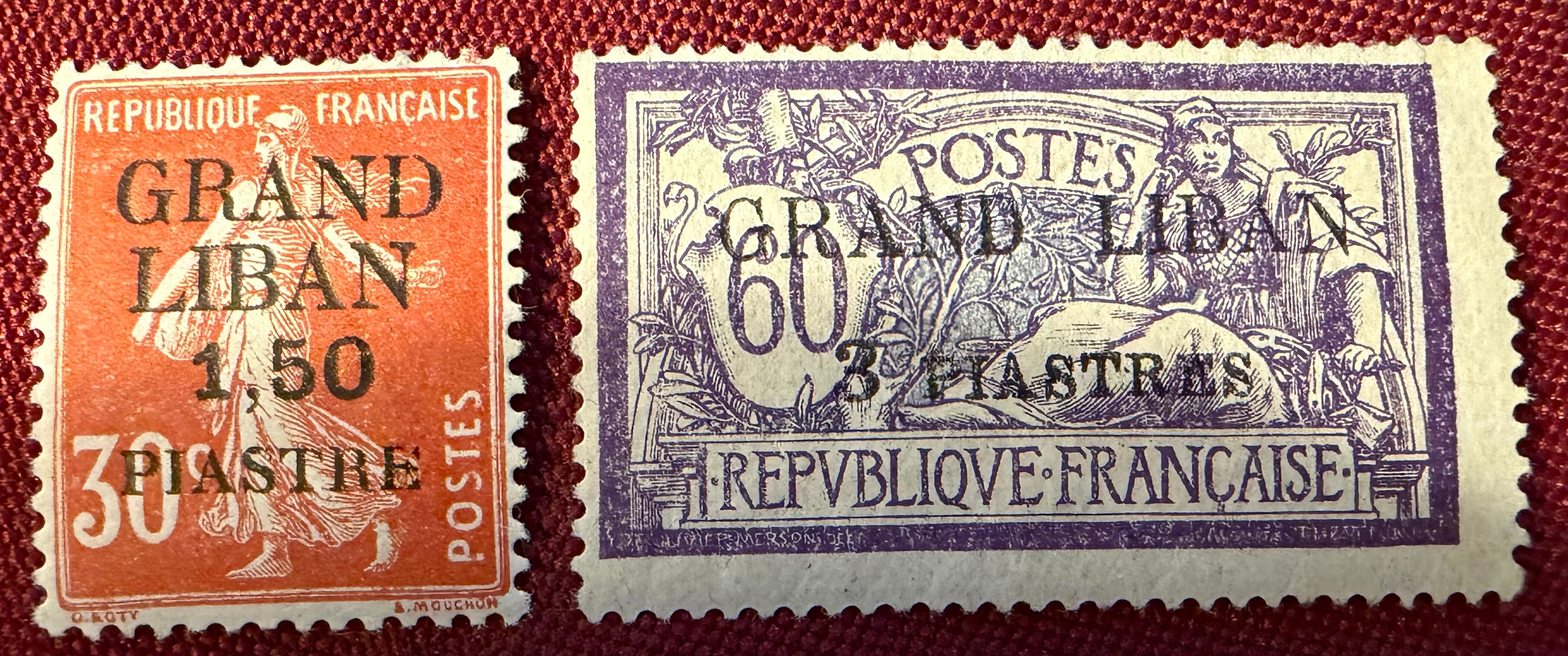
Two of the first set of postage stamps issued for Lebanon in 1924—stamps of France overprinted Grand Liban
In recent years Syria acted as lynchpin facilitator between Iran and its Shi’i proxy Hizballah, which over time essentially took the Lebanese government hostage and expunged the country’s de facto sovereignty. Now that the younger Asad has been displaced—the Russian position in Syria with it—and the still-lingering last pained gasps of a horrific civil war have been extinguished now some eleven months ago, powerful wounds dealt Hizballah by Israel are combining with the still shaky but hopeful rise of a new order in Syria to presage the restoration of genuine Lebanese sovereignty, open a path for political reform and national renewal in that country, and thus set the stage for an Israeli-Lebanese peace treaty.
Sounds like a good idea, and it is; but no peace between Israel and Lebanon can come about—so that Lebanon can join Egypt and Jordan as Israel’s contiguous neighbors at peace—until a new and improved modus vivendi between Syria and Israel is established. Just as Jordan could not move toward formal peace with Israel before Egypt, and before at least some promising symbolic movement on the Palestine question, Lebanon cannot go before Syria. That’s just the way it is.
So the recent successes of Israeli arms, broadly defined, applied against Iran and its proxies in the region—to include the Houthis in Yemen as well as Hizballah in Lebanon—have opened a major opportunity for geopolitical advances in the region that can benefit many countries, not just Israel. But there is more: While it is not yet evident to causal observers, these regional developments, with well-designed diplomatic effort that need include at some point a major U.S. mediation contribution, be may fashioned to double back to catalyze a breakthrough in the region’s most intractable and depressing problem, the Israel-Palestine morass.
But here, too, a real political breakthrough, over and above the current tenuous and overhyped ceasefire to the Gaza War, will require combined causal elements: a more convivial regional context must be joined by a decompression and change of valence in Israeli domestic politics, a development still uncertain but that may also possibly be advanced by an improved regional context. In short, as heart shredding as the images from Gaza, and Lebanon, have been now for more than two years running—and they have been heart-shredding to anyone with a heart no matter one’s partisan inclinations—we have reason for cautious optimism now regarding the whole bulging portfolio of Levantine misanthropies.
It is hard for many observers to get their heads around even the possibility of reasonably happy endings in the Levant. Jewcentricity again plays a role here. If one is obsessed with the seemingly endless cycles of doom, gloom, and ka-boom, rinse tears away and repeat, in Israel-Palestine affairs, it can become hard to notice things happening, even fairly nearby, to the north and northeast.
Talk, Talk, Talk, Email, Email, Email
This is complicated stuff. All of it has a history, a relevant history let me insistently add, the mastery of which sums to a day-job pursued over many years. We’re not about to windmill joust at that history in a mere Substack post. But now that the gist of the matter, and the stakes at play behind President ash-Shara’a visit have been briefly laid out, see if you can follow two separate, but marginally linked, email conversations I have had in recent days. I will help you by annotating possibly esoteric references in these conversations with explanatory notes in parenthetic italicized comment….. (I’d prefer to do this in actual footnotes, but the Substack template won’t let me: It dumps footnotes at the end of essays whether I like it or not, which makes it much harder for readers to connect main text and notes.)
Conversation One: Fred and Me
“I have an idea, Fred. Maybe not original, but it’s original to me now, and it really could work: Let’s create the Hermon-Golan International Environmental Zone, put the Druze in charge in their own autonomous buffer zone (including Druze communities on both sides of the line), and declare the area Tri-Sovereign: Israel, Syria, and the DAZ (Druze Autonomous Zone). Israel would be responsible for external security; the Druze would own a beefy police force and run the ski slope for a nice profit; and Syrians would be able to come and go as they please and set up businesses, as well. We should give the UN Environment Programme at least some symbolic role, the better to tease out EU monetary contribution toward the expenses that would be entailed in creating the environmental zone. Creating the DAZ as a buffer between Israel and Syria is, as you may observe, not absolutely necessary; but hey, buffers are good.
Maybe even too, under new conditions and context, the Wahda/Unity Dam in its original concept could finally be constructed and a water sharing arrangement worked out to the benefit of all riparian parties. That would be gravy if it could be arranged, but tasty gravy, no?”
[Fred is Fred Hof, the U.S. diplomat who spent more time with Bashar al-Asad before the outbreak of the Syrian Civil War in March 2011 than any other U.S. official. See his revealing and shrewd 2022 book Reaching for the Heights: The Inside Story of a Secret Attempt to Reach a Syrian-Israeli Peace. Fred was also involved, working with Ambassador Richard Armitage, in the 1989-90 mediation attempt to negotiate a deal that would have allowed the construction of a large dam on the Yarmouk River, to be financed by the World Bank. I’ve known Fred a long time…. The Druze are a small (roughly one million in number) but interesting and strategically placed heterodox para-Islamic minority group living mainly in the area around Mt. Hermon and the Golan Heights.]
“Yes, Adam: Brilliant and requiring 20 minutes or less to accomplish in detail. Seriously: formal peace will require creative approaches to Golan sovereignty, so don’t be surprised if something close to your formulation gets serious consideration. For now, a step-by-step approach is required: First, the IDF will need to return to the ‘74 lines with Syria in the context of some limits on Syrian forces in the Suwayda area; second, an armistice permanently terminating hostilities and ending the UNDOF mission will have to be negotiated; and then, third, once the sides get used to a new status quo, and it sticks politically in both countries, a formal peace will need to be negotiated, ideally on the basis of the Garfinkle Plan.”
[The ’74 lines refer to the step-by-step agreement brokered by U.S. Secretary of State Henry Kissinger after the October 1973 Middle East war; those lines moved Israel back from the territory it held after the June 1967 War. But in recent months Israeli positions have crept further into Syrian territory with the collapse of the Syrian state since December 2024—hence the need for readjustment back to an agreed line. Suwayda is a town in southwestern Syria near the Jordanian border……just look at a map. The UNDOF mission is the United Nations Disengagement Observer Force set up in May 1974 as part of the U.S.-brokered Syrian-Israeli disengagement agreement.]
“Heck, Fred, you’ve done it! You’ve put the whipped cream and the cherry on top, and filled in what the on-ramp to a final status arrangement must include. I agree totally. So why aren’t we—especially you—in the thick of this stuff? Are we just too old?”
[Fred is 78; I’m 74]
“Well I’m feeling my age after just completing a very intensive, three-month Israel-Lebanon Track II project. Multiple trips to the region convinced me that jet lag doesn’t improve with age. If you’d like to see our just-finished final report, let me know.”
[So, to my surprise, I learned that Fred has been in the thick of things, which made me a bit jealous. While I was recovering from knee replacement surgery he was commuting back and forth from Pennsylvania to Lebanon. Sheesh…. Track II diplomacy is a form of informal, unofficial diplomacy in which knowledgeable experts, sometimes retired government officials, try to set the stage, feel out local mindscapes, and get creative in ways governments often have trouble doing—for reasons we’ll just leave aside for the moment—to jumpstart or aid a diplomatic effort. This European-sponsored Lebanon-Israel Track II effect was led by Fred, using his Bard College affiliation, and John Bell, head of the Conciliators Guild in Toronto. Just by the way, Track II diplomacy was a mainstay of what the U.S. Institute of Peace used to do before the Trump 2.0 Administration raided the building and all but destroyed the USIP back in March.]
“Sure I’m interested, Fred. I had no idea you were still beating yourself silly flying all over tarnation. Don’t you know how to relax? Me neither, speaking of which I really enjoyed my 3-4 hours at MBN today: maybe 15, 16 reporters, editors, tech types, etc....—from Sudan, Saudia, Syria, Lebanon, Morocco, Yemen, ..... It was a bit like hanging out again at the al-Mesbar Centre in Dubai. There was even a potluck lunch afterwards, and an Egyptian guy made excellent Umm Ali. I was transported, my taste buds at least, back to Cairo......
Anyway, I briefly debuted for the MBN staffers what you delightfully call The Garfinkle Plan for a Hermon-Golan Environmental Zone, and gave you credit by name for the whipped cream and cherry. Some of the Lebanese in the room recognized your name, so a question: If some of the MBN reporters and editors want to talk to you, should I provide them your POC information? Or not?”
[The al-Mesbar Centre in Dubai, UAE, is a rare liberal pro-civil society and democracy research organization in the Arab world, staffed by Arab scholars and journalists from across the region. From 2015 to 2021 I was a columnist and associate of al-Mesbar. Umm Ali is an Egyptian dessert concoction to die for. MBN stands for Middle East Broadcasting Network, the part of the U.S. Agency for Global Media (USGMA) that broadcasts in Arabic to the Middle East and North Africa (MENA) region. Within the USGMA are other, probably better-known “radio” media like Radio Free Europe and Radio Liberty. MBN’s constituent parts are today operating at a greatly reduced metabolism thanks to the Trump Administration’s illegal impoundment of funds authorized and appropriated by Congress. The Administration brought Kari Lake to town from Arizona to wield the axe over the USGMA. As part of the effort she signed a no-bid contract at exorbitant rates with the Ragnar Group—organized by people associated with a former USGMA director during the first Trump Administration, Michael Pack, who did not have the best interests of the radios at heart, to put it mildly—to find nonexistent “waste, fraud, and abuse” at MBN….just another in a long list of corrupt arrangements with MAGA-friendly sycophants outside of government to simultaneously attack enemies and plunder public coffers.]
“Adam, the three components of the final report are attached below. As for media, I’m laying low these days. Somehow the Lebanese press did not pick up on my three visits to Beirut, which was good. The last thing I needed was for some Lebanese reporter to make us more high-profile than would have been useful for the mission. And I don’t want anyone in the U.S. government trying to work these issues to see me and my Canadian colleague as competing or interfering with what they may be doing. Our objective is for officials to pick up on our recommendations, implement them, and take credit for themselves.
About recent developments, it appears that Shara’a spoke with Trump about a process identical to the one I suggested might be the most feasible: IDF withdrawal to ‘74, a bilateral security agreement, and ultimately peace talks. If Syria and Israel can establish and sustain truly peaceful relations starting soon, I would not rule out some kind of shared-sovereignty Golan Condominium taking shape five years from now, or maybe sooner. I think Shara’a’s intentions are good. The real question is whether he can put together a stable governing coalition and an effective administration to implement the coalition’s policies. As for Bibi, someone with whom I developed a good relationship 15 years ago, I hope he opts for a peace offensive with both of Israel’s northern neighbors.”
[All this is pretty straightforward. IDF means Israel Defence Forces for those who may not be familiar with the abbreviation. The three components of the final report Fred mentioned are not (yet) in the public domain, and so I hesitate even to give their titles or otherwise describe them. All I’ll say is that it’s very good work.]
“On the media and the MBN crowd, I hear you, Fred. If you have reason to change your priorities in future, that tack can be activated.....assuming Kari Lake does not succeed in killing all the radios by then.
Just to note: All three Lebanese at yesterday’s MBN session were pretty young and one “Lebanese-American,” as he described himself, emitted an undercurrent of irritation and suspicion about the man he called “al-Jolani” and not ash-Shara’a. At some length he suggested that ash-Shara’a was not being candid and that he was not trustworthy. He expressed frustration that members of the press did not challenge him more vigorously about his terrorist past. I suggested in answer that at a public diplomatic event one is wise not to piss into someone’s soup unless he gives you a reason. I added that people can and do change and that contexts always change; the zeitgeist in the air when ash-Shara’a went off at age 19 to Iraq to join a jihad has long since dissipated with the churn of a generation. Most Arab adults in the region realize that the waves of neo-fundamentalist Islamic violence that peaked more than a decade ago ended up killing more innocent Arabs than it did others.
So the issue, I said just speaking for myself but echoing your own assessment, is not his intentions, which I will benefit-of-doubt him until I have evidence to the contrary, but his ability to govern. And as I stressed to another Lebanese doubter at MBN, these are still early days and the ensemble of challenges as-Shara’a faces remains massive. The takeaway, I think, is that given what Lebanese have suffered from and through Syria in recent decades, there may be more resistance to helping this guy in Beirut right now than there is in Washington.
I also mentioned in a passing denouement that it might soon be time even to revisit the original Wahda Dam idea in a new and improved political context. I soon regretted saying that, realizing that many of the folks at the MBN session were in diapers the last time that subject was big news, nearly 36 years ago. Don’t time fly when you’re having so much fun?”
Conversation 2: Dan and Me
Dan Kurtzer and Aaron David Miller are veteran, deeply experienced now-retired but still active State Department experts in Middle Eastern and specifically Arab-Israeli affairs. In recent years they have formed a partnership to provide periodic expert commentary on regional developments. Dan Kurtzer served as U.S. Ambassador to both Egypt and Israel; Aaron David Miller worked for 24 years serving six Secretaries of State on Arab-Israeli issues; nothing about U.S. Middle East diplomacy in all those years was untouched by Aaron’s steady and constructive hand.
Not that it matters, but both Dan and Aaron are 76 years old, two years younger than Fred and two years older than me. Do we all know each other? Yeah, we do.
Anyway, Dan and Aaron recently wrote an excellent analysis for the Carnegie Endowment for International Peace entitled “U.S.-Israeli Relations Are Undergoing a Profound Shift” and published on November 13. If you missed it, and have the background to understand serious analysis, here it is to pop into your browser: https://carnegieendowment.org/emissary/2025/11/us-israel-relations-trump-netanyahu-gaza-ceasefire-shift?lang=en
Dan and Aaron always ask if readers on their list have comments. I don’t always but this time I did, and they link back to the ash-Shara’a visit to Washington and to Fred’s recent labors. Here is how the exchange went, and again, as in conversation #1 above, I am paraphrasing, not quoting verbatim from the email texts.
“You want comments, Dan? OK.
On the whole you (plural, you and Aaron) are of course right on all your main points. I made the same basic case yesterday morning to a dozen+ Arab journalists at MBN out in Springfield, Va. Except that, despite the language barrier—no, not THAT language barrier.....I know a little bit of Arabic—I used different terminology at one point to get across to them. The U.S. is to Israel, deep down and always in potentia despite the capacious meanderings of the past history of the relationship, as the poritz always was to the hofjude in eastern Europe for more centuries than the independent United States of America has existed. Now, after Netanyahu’s extraordinarily foolish caper years ago—which you mention in the piece—to partisanize American Jewry’s clout viz Democrats and Republicans, the true nature of the relationship, as it has come to matter most for the future of Israel, is becoming clearer.
[The terms poritz and hofjude translate out of Yiddish roughly as “wealthy landowner” whose lands may include a Jewish shtetl, and “court-Jew,” respectively. However smooth and mutually beneficial a relationship might be between a Polish baron and a shtetl representative, there was never any doubt about who held the upper hand in case of a serious argument or a conflict of interest.]
I would pick two nits on less important particulars. First, I’m not convinced that anti-Israel sentiment from the Gaza war made a significant difference in any of the seven swing states in November 2024 except maybe Michigan (at a mere 1.42% divide, maybe....). And second, the statement that Netanyahu needed Trump to achieve success in the 12-day war against Iran in April leaves me puzzled.
Seems to me that Trump decided to piggyback on Israel’s devastating operational successes—which would have stood even had Fordow not been attacked by U.S. forces—once he was convinced that sending U.S. aircraft into the theater was risk-free since Israel by stealth had disarmed Iranian air-defense capabilities en toto. As I argued in Quillette (“The Twelve Day War: Truths and Consequences,” Quillette, July 5, 2025), Trump’s unpredictability set Israel’s timeline for acting, for fear that about-to-recommence U.S.-Iran negotiations might quickly produce something genuinely troublesome for Israeli interests. But that doesn’t translate, as I see it, as Bibi needing Trump for anything decisive to successfully hand the Iranians their asses, not even the important but more or less standing U.S. role in Israel’s air defenses against incoming Iranian missiles and drones (maybe that’s what you’re referring to?).
Finally, a point that went unmentioned in your piece, but of course I realize that op-eds have strict length limits in terms of what one can say. Netanyahu has in front of him, before coming elections, a major opportunity to burnish his prospects by taking intelligent advantage of new prospects for peace diplomacy with Syria and Lebanon. I’ve been back and forth lately with my old friend Fred Hof, who’s been to Beirut three times in the past three months on a Track II project with a Canadian counterpart, and I’ve got text of the final report of that mission. (It makes for interesting reading; I can forward if you like and Fred agrees.)
These prospects, on the heels of ash-Shara’a’s visit here, are as historically consequential perhaps as the cumulative changes you point to in U.S.-Israeli relations. As I stand back and look at what would need to happen for an Israeli-Syrian arrangement to work, thus opening the door to a follow-on Israeli-Lebanese advance, it seems to me that Netanyahu has about as much leverage over Trump as Trump has over him. He can veto progress with deeds and non-deeds if he wants, and use that prospect to mollify and moderate any sticks that Trump might want to beat him with. It seems a somewhat more balanced situation than the one in Gaza, where a U.S. threat to withhold military aid to Israel is far more logical and plausible in light of any newly distressing images from that theater.
If Netanyahu still has brainpower to use for any objective other than staying out of jail he’ll push the accelerator to the floor in the North, and dither and deflect on the massively difficult and unfinished business to the South. The domestic politics are so much easier here for him, too: As you are well aware, there are existential-level disagreements in Israel over the ultimate disposition of Gaza and the West Bank, but only crazy people in Israel oppose pursuing peace deals with Syria and Lebanon if they can be gotten on decent terms. This is his re-election ticket, if done right. You take the point, I’m sure. Of course, it galls me to no end that Netanyahu might pull his ass out of the political fire this way, but I won’t lose sleep over it if it happens. So much competition on that score, you know.”
“Thanks, Adam, for comments. Interesting perspective, especially re Syria and consistent with what I have been talking to Ryan Crocker about. Please do share the Hof paper you mentioned.
[I mentioned to Fred Dan’s interest in seeing the Track II texts, and Fred said he’d send them to Dan directly. Ryan Crocker, former U.S. Ambassador to Afghanistan, Iraq, Pakistan, Syria, Kuwait, and Lebanon, happens also to be heard of the USGMA. I’m still a bit peeved at Ambassador Crocker for refusing to let me go into Islamabad to look around in March 2005, instead stranding me at the Serena Hotel and the embassies compound for almost three days.]
One disagreement: I stand by the judgment that Netanyahu could not finish the job in Iran without Trump. Until the US intervened, I had assumed Israel had a plan B for the fortified sites; but I’m not sure they did, and I’m sure they did not want to send in ground troops.”
“Yes, Dan, we do see an aspect of what happened in April differently. The attacks on the nuclear plants set the Iranian program back, so every responsible analyst has said, but they did not destroy it. Thus, the US contribution, I think it’s accurate to say, likely added some to the set-back; but judging how much does not depend necessarily on having hit or not hit Fordow, but rather on what the weakest link in the whole program was/is, and I don’t know what Israeli intelligence judged that to be.
[Iran’s Fordow nuclear installation was and still is believed to be the most important and best protected of Iran’s nuclear program sites. Israel lacks the deep penetration ordnance needed to put Fordow out of commission and also lacks the aircraft capable of carrying and delivering that ordnance.]
Beyond that, I think the Israelis: (1) would have judged the attack a major success even had the US not joined, because it even more firmly established and advertised Israeli combined-arms escalation dominance for all in the region to see—in the pre-attack neutering of Iranian air defenses and in the pinpoint targeting of key Iranian leadership figures, suggesting that Israel could take out the big ayatollahs from the sky if it wants to at any time; and (2) I agree that the Israelis did not have a Plan B involving landing special ops teams in Iran....a deterring combination of too far, too hard, too risky. I think the IDF sees the problem as long term for as long as the Iranian regime remains standing, and so militarily multi-phased.”
See, TRP readers? This is complicated and highly interwoven stuff. So a final word of advice: Should you encounter anyone who claims to know how simple, clear-cut, and obvious the answers are to all these problems, uncertainties, and prospects, just smile, walk away, and so stop wasting your time.
Next week, not sure: Probably back to Trump 2.0 and The Age of Spectacle. But who knows what the world will throw at us, right?