Facing the Music
Post-January 20, 2025 AoS Chronicle, No. 51

It’s Wednesday, it’s that established time of the week for a post, I like to stay consistent and predictable (within alluringly unpredictable parameters) especially for loyal TRP readers, yet….alas…..the well is either dry or overflowing, depending on how you look at it—depending, actually, on how I look at it.
Overflowing? It could be, sure.
I could write, for example, about how the Supreme Count’s spurning of the Voting Rights Act, which many commentators have seen as a blatantly partisan pre-midterms political act unbecoming of the SCOTUS’s constitutional mandate, is actually more complicated than that. It can be seen—as I see it—in the same light as the conundrum of affirmative action, of which it more a part historically than it is about some putative representational ideal. American society remains in awkward thrall to a nearly impossible balancing act between respecting the ideal of a color-blind society, what Dr. King espoused repeatedly, and apologists and manipulators aside, I think sincerely, and acknowledging the sticky legacies (plural, they are continuous but not identical) of slavery and segregation. Ideally, congressional districts’ definitions should never be subject to partisan gerrymandering. Either creating artificially or proscribing artificially majority-minority congressional districts is wrong, and preventing the twain is not a bridge too far: If the State of California once did it (Proposition 20, in 2010….it worked…..you could look it up, if you don’t remember it), by turning the task over to a neutral technocratic minded citizens’ committee that all sides pledged in advance to respect, then the other 49 states can do it, too—and California can do it again. I am extremely leery of elevating a subject to the level of a potential constitutional amendment, but in this case I am sorely tempted to propose doing just that. It is what both genuine egalitarian norms and democratic theory would demand, all else equal.
But I won’t propose it, not right now. Because I am not writing about what the SCOTUS did recently concerning the Voting Rights Act, and how best to frame and thus understand the large issues at stake.
I could write, for another example, about the President’s trip to China, ongoing as we write and maybe you read. Much commentary exists about the trip already, and the big meetings have yet even to occur as I write. I am not a China expert, and anyone who cannot read Chinese should not pretend to be….my persnickety opinion, take it or leave it, as you like. But I can predict that whatever goes down in Beijing is going to cause a lot of heartburn among the Administration’s motley and divided policymaking crew concerned with China. My friend Drew Thompson, a former Director of the China desk at the Defense Department, pointed out in a shrewd and deeply informed RSIS Commentary last year that three distinct points of view are represented in the Administration, distributed among the Defense, State, Treasury, Commerce, and Justice Departments, and amid the Trade Representative’s office and of course across the IC—to wit:
There are, first, the China hawks, who would defend Taiwanese independence from PRC aggression to and perhaps beyond the nuclear threshold, and who believe that a major war with China is inevitable. (I do not share their views.)
Then, second, there are the isolationists who would not use military force in any manner outside of the U.S. Western Hemisphere neo-imperial sphere, and could barely care less what China does, even to longstanding U.S. allies like Japan and South Korea, in its Asian sphere. (I do not share their views either.)
And then, third, there are those who see China as a threat not in the traditional geopolitical sense, but rather in an economic and scientific-technical sense befitting a revenant mercantilist U.S. mindset masquerading as a foreign policy paradigm. (No, I do not share their views, as you might have guessed. Well, then, what are my views? Wouldn’t you like to know? But I’m not writing about Sino-U.S. relations today.)
And where does Trump stand amid these three schools of thought? Everywhere, and therefore nowhere. He doesn’t stand at all; rather, he equivocates inconsistently by crouching, slithering, and pretending on occasion to hide, so there is no telling how he will respond to President Xi’s blandishments and demands. By now he probably is at least vaguely aware that his policies have dumped the U.S. economy into the crapper. Farmers, one of his core constituencies, have been hurt very badly, as have an array of retail and wholesale industries dependent on foreign inputs and sales alike. So my guess is that trade will mainly be on his mind; with Scott Bessent by his side (he took no professional diplomats or China experts with him on the trip…..professional diplomats and experienced experts are about as welcome in the Oval Office these days as cholera bacteria) he’ll likely seek to walk back his many errors since January 21, 2025, albeit without admitting that any errors were made. (Donnie and his Purple Crayon from Hell never rest in the quest to murder the entire Lebenswelt in favor of Trump’s fantasy reality de jour.) I suspect that will take precedence over anything to do with the mess he has made for almost everyone viz Iran, and over insinuations and deliberately clouded abstractions concerning Taiwan’s status and future. So no, this trip will not supply Trump a “Get Out of War” card. He will still be stuck in the same dilemma when he’s returned back stateside: How to capitulate to the new, more divided but more radical and murderous Iranian Islamic regime without it appearing to be what it actually is. Either that or he radically escalates the fighting, on yet another late-night hatched whim. (God help us all if he does that.)
How will all of this come out in the wash when the trip is over and the outcomes are more or less manifest? Well, as I have already told you, we’re not writing about Sino-American relations in this post, so don’t ask me. Ask or consult someone who is truly expert on his, like my old friend Kurt Campbell, who has a new Foreign Affairs essay prepared for just this purpose.
Then again, I could write about what’s been going on in Israel. Sometimes it feels like everything is going on in Israel, nearly all of it heartbreaking, and all of it tangled into a huge mess. We have: settler violence, more coordinated and serious than ever; the coalition withdrawing controversial proposals that might tank the coalition even before the planned October Knesset election in order to beat the bad odds projected out to that time in the autumn; the IDF moving further than ever into southern Lebanon, past the Litani River, but under U.S. impelled ceasefire conditions that have put Israeli soldiers there in harm’s way to gratuitous excess, a tactical stupidity Naftali Bennet has been trying to make hay from; reports of IDF mass looting in southern Lebanon, not befitting the IDF’s “purity of arms” doctrine; the politicization of Mossad leadership and methods; and more. All of this of course is related in one way or another to the fluid but frenzied jockeying and backstabbing going on in advance of the scheduled October election.
I’m not reading the Hebrew press as assiduously as I once did. If I were reading it, no doubt I would discover that the complex mess I just described in brief is in truth many times more complex even than that. But then it would take me an entire long-form essay just to do it bare justice. So it is a good thing we’re not writing about Israel in today’s post.
I could also write on the Defense Department’s obsession with bringing AI everywhere into its routines without a care for how the technology will mesh with adopted techniques and their social embodiments in the bureaucracies, military and civilian alike. Ignoring those two legs of the what is always a three-legged stool when it comes to the practical impact of technological innovation could end very badly. No one at the Pentagon seems to care enough to raise the danger flag…..with Palantir de facto calling the shots. No, not doing that today.
Or I could write on how much I despise the new robotic second-guessing of umpires in Major League Baseball, or the phantom extra-inning base-runner rule from the 2025 season, or the designated hitter rule from many years ago which I still hate down to the aching arthritis bones in my thumbs’ basal joints that used to be able to hold and swing a Louisville Slugger. I’m not going to bemoan the reduction of baseball, the Church of Baseball said Annie Savoy in Bull Durham, to mere spectacalized impatient entertainment for majorities that these days who have themselves never learned and played the game. Nope, not going there either: My doctors advise me to avoid needless stress, you know.
Or I could write about my intuition that the conspiracy theories that have burgeoned into prominence and political clout over the past decade may evoke, parallel to clinically documented acquired autism and acquired ADHD symptoms, what may be acquired schizophrenia symptoms. You remember or have heard of the 1957 film The Three Faces of Eve, a fictional version of a real case of split personality—now called dissociative identity disorder (DID)? Well, schizophrenia, a visual prediction-error phenomenon (since it apparently never happens to congenitally blind people), doesn’t always result in multiple personality outcomes, but instead in a multiple reality outcomes. Conspiracy theories, however else they may be described, are oral scripts, these days modeled not necessarily in content but in structure after the massively popular fictive oral scripts—think Game of Thrones, for example, or Outlander—that many people absorb from overdosed screen-based entertainments. With the very same technologies delivering both entertainments and so-called “news”—really infotainment based on images and forms of orality rather than writing of any kind—it is not surprising that lines in the minds get blurred between what is real and what is surreal, especially among the post-deep literate crowd, which now easily surpasses half of the adult American population.
Thinking that a conspiracy theory with no basis in fact is real, it seems to me, qualifies as a form of acquired schizophrenia. It’s very much less serious medically than actual clinical cases of diagnosed schizophrenia, and likely may be relieved simply by the patient avoiding screen overdosing for a few weeks. But when acquired schizophrenia symptoms are teased into mass peer-pressured reality by conflict entrepreneurs—say, about what actually happened in November 2020 and on January 6, 2021—then it may not qualify as medically serious, but it sure as hell qualifies as politically serious, no? Ah, well, but I’m not writing about that today in this post. So you don’t need to construct an answer.
OK, then, so I’m not doing any of that. The well is dry, bone dry. What does that leave us? What am I writing about today? Music, specifically a concert I attended last evening.
From “Songs of Love and Peace” to “Seek and Destroy”
Yesterday, May 12, was our granddaughter Joni’s 27-month birthday. Since her father got a part-time job, my wife and I have often volunteered to take Joni to school at the Clerc Center (the Kendall School, to be specific) of Gallaudet University, down in the city on Florida Avenue, NE. It takes us a good 45-50 minutes to pick Joni up at her house in Takoma Park and then get her down to the Parent Infant Program (PIP) by about 9 AM, so my wife drives and I sit in the back attempting to entertain Joni on the ride. Yesterday, Joni with her cochlear implants on and working—we usually takes them off her head when we get to PIP class so she can focus on learning ASL—we tried singing. We started with “Row, Row, Row Your Boat,” my wife and I soon blending into the well-known round for which that song is ideal. After about the twelfth rendition Joni began to get the hang of it. So good. But “Row, Row, Row Your Boat” can be a helluvan-earbug--so catchy, you know?
Why tell you this? Because my wife got tickets for a concert last evening at the Fillmore, in beautiful downtown Silver Spring, just down the road from Antebedlam and Chicken Belch Farms in Wheaton where we live. She got these tickets partly based on a conversation with out eldest son—Joni’s uncle—who got us curious about what Mongolian Throat Singing was. I was curious. Not curious enough to shell out $168 for two standing-room tickets. But my wife evidently was curious enough, seeing as how that is what she did! (She also spent $40 on a t-shirt before the concert, but that’s something else again.) So we stuck the car in a parking garage and walked over to the Fillmore for the show starting at 7 PM.
The show? The opening act was a Finnish heavy metal band called Therasmus, which I had never heard nor heard of. The second act was another Finnish band, Apocalyptica, which evidently plays only Metallica covers on three celli, with a drummer in accompaniment. Had never heard nor heard of them. The third act was a Mongolian band called The Hu. Had never heard nor heard of them either.
The venue was mobbed—many hundreds of people, standing room only and there was no extra standing room. It was quite a diverse crowd, certainly in terms of age. Hardly any black folks except those working as staff for the event…..but otherwise pretty diverse. We climbed to the second-floor balcony to get a better view, and to avoid what we were warned might be forced mosh-pitting activities. (They turned out to be very modest, a pittance really.) There were some seats up there for patrons willing to reportedly pay $600 per ticket for the right to sit down. We stood the whole time, for the acts and the two intervening intermissions—a total of more than three hours. Had to thank my ortho surgeon, too, since before my knee replacement this past July, no way I could have done that.
Well, you know, I thought maybe Mongolian Throat Singing was some sort of exotic folk music genre, maybe a little like Japanese koto music. So I imagined, possibly, that I would encounter an a cappella singing act. Nope. Therasmus was straight heavy metal: singer, drummer, base player, guitar player, and I thought someone just off-stage was dumping other keyboard/synthesizer sounds into the mix while no one in the audience was looking. Apocalyptica was weird heavy metal since I never imagined that three celli with a drummer could possibly sound like Metallica, but they did—actually, they sounded better than Metallica because these three guys were each virtuoso performers on their instruments. The Hu? Folk genre? Hell no: More heavy metal. One fellow played a kind of Chinese-looking two-stringed viola….what do I know from traditional Mongolian instruments? The rest was not the least exotic—although I learned after the concert that The Hu can and does do, or did, actual folk music with native instruments. I saw a video clip on the internet of the band playing that way in a studio a few years ago, and it was altogether delightful and interesting…..but that is definitely not—emphasize NOT—what they did at he Fillmore on Tuesday evening.
All three bands came with their own bespoke light show and backdrop film. This is heavy-metal obligatory, I am given to understand. The show at the Fillmore last night was the first in a U.S. tour that will take the three bands to 26 additional venues from coast to coast.
All I can say is good luck, everyone on that tour, because in my view—with some exceptions in the Apocalyptica set thanks to some truly superb musicianship, not to exclude the amazingly talented drummer—this stuff is unmitigated crap. It’s not really music at all, if a melody is taken to be an obligatory part of what music is. This is head-banging noise. It is the equivalent of frustrated males—all three bands were 100 percent male—throwing a musical tantrum because (again, some of Apocalyptica’s set excepted) it seems that they’d really like to know how to actually play their instruments well, like actual musicians, but they don’t—or convincingly act like it. So they turn up the volume and the fuzz on the bass guitar, occasionally extracting some ear-splitting feedback by so doing, as a compensation. It’s like American tourists abroad speaking English much louder to people who don’t understand English, thinking maybe that additional volume and emphasis will make the difference.
I don’t consider myself a professional level musician on guitar, or mandolin, or anything else I fiddle with that has strings. But I can haul out my blond-wood Rickenbacker, purchased in 1972 for $400, plug it into my amp, turn the volume and reverb up past ten all the way to painful, and make most of the same sounds—if I wanted to—within about twenty minutes. I don’t want to.
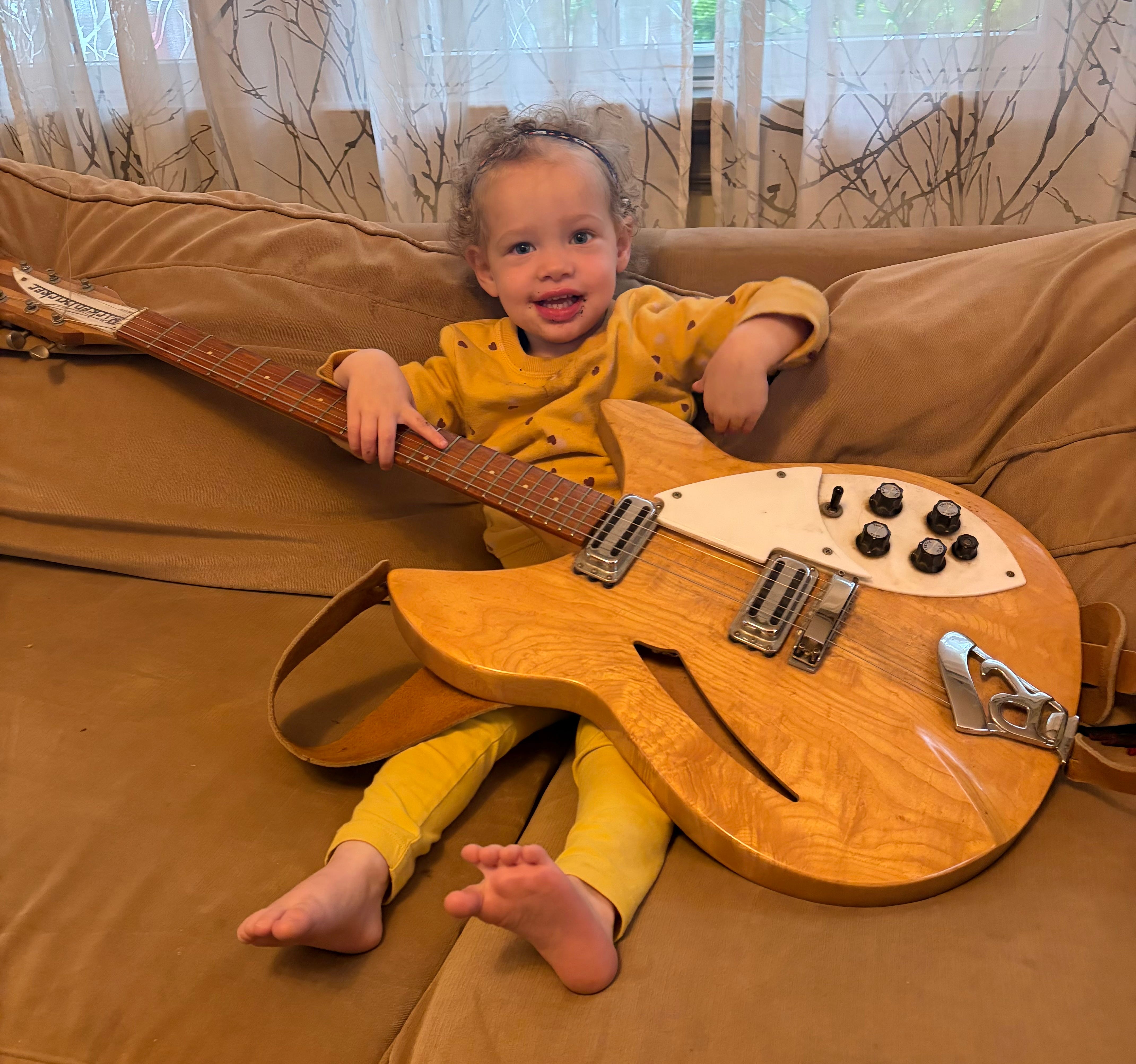
Joni practicing on the Rickenbacker; she’ll flip it around eventually….
There’s a pattern to most of this would-be music, insofar as it is music at all, in terms of chord structure. In normal music, like folk music’s standard circle of fifths structure, the intervals between chords, major and/or minor, tend to be whole steps, or multiples of whole steps—so on a guitar, changes of two frets, or four, or sometimes five. But in heavy metal, after pounding on the same chord in time to the drummer for a while, sometimes a long while, the most characteristic shift is one fret down or up—usually down—so a half step, say from an A chord up one fret to an A#, or from an A down one fret to a G#. This grinding ratchet noise sounds dissonant to most ears, and is so designed. It’s cringe music, music one supposes appropriate to the end of the world, like music as a sound track to the Book of Revelations, music for the Apocalypse….. Apocalypse, Apocalyptica, get it?....
Who in their right mind, and heart, actually likes sounds such as these, and why?
Before not really answering that question, let me describe the lyrics I heard last evening. Though it is a Finnish band Therasmus sang in English, presumably because that is where the market and the money are for what they do. But I could barely make out the words for the screaming—that’s really mostly what it was—and my hearing is fine. I did make out the song lyrics and title to one number: “Guillotine.” And what little I could glean from the other numbers similarly sounded dark, violent, deathly, and blood-soaked, rather like the art on the shirts most of the audience members were wearing. This is dystopian stuff simulating a loud nightmare. Assuming that not everyone into this genre either commits murder or becomes a suicide, what we seem to have here is fraudulent nihilism with a strong beat marketed as pseudo-heroic musical stoicism. Sort of pretend thanatos; perhaps Freud would have found it of interest. One of the most popular numbers of Apocalyptica’s Metallica covers, to the Fillmore crowd last evening, was a song entitled “Seek and Destroy.” Really.
As already intimated above, I am at a loss to answer my own question about the heavy metal phenomenon. It’s just bad music, so love of art cannot be behind its poplarity. So what is it then? Well, here is not an answer but, well, call it a hunch.
We live in The Age of Spectacle, a time of obsession with entertainment, the more fantastic and otherworldly the better for the most part. It is an age devoted to escaping the terror of boredom—but even boredom is not what it used to be. It has shapeshifted when we were not looking as the culture moved from an Abrahamic religious age to whatever age this is, whether Philip Rieff’s “deathworks” (look up the reference on your own, please) replete with apocalyptic entertainment memes, or something less dramatically somber. It may simply be that disenchanted minds, to use Max Weber’s famous formulation, have a harder time with boredom than enchanted ones. Enchanted minds see a world filled with wonders and portentous action and multiphasic personal eternities; disenchanted minds see an ultimate nothingness never very far ahead, and nothingness is unnerving, since it works as a synonym for a personally obliterating mortality. That is where the popularity of apocalyptic entertainment—possibly including heavy metal pseudo-music—now attaching itself a bit too gleefully to artificial-intelligence scenarios in an anodyne anti-boredom mode, comes to play: It’s a convenient way to dramatically upshift one’s personal sense of mortality dread in a post-afterlife culture to a general and hence anesthetizingly anonymizing one. It is also the non-incidental case that, as David William Silva put it succinctly, in the current proto-nihilistic, collective-mortality, moment: “Fear is insanely lucrative.” No doubt about it: The Therasmus/Apocalyptica/Hu tour is going to make a buttload of money.
There is, I suppose, another—or a supplementary—possible answer to my puzzlement. It resides in this question: Were any of these head-banging fist-pumping types sober last night? Could being habitually gourd-gone account for their musical preferences? I had to wonder. The guy sitting just in front of me was swigging from what looked to me to be a half-full whiskey bottle (when I got a glimpse of it halfway through the concert) lovingly stuffed with ice shards, but that’s just one guy. The bars—a long one downstairs and a smaller one upstairs—were doing a brisk business: beer and a shot, just $20. The smell of weed in the parking garage as concert-goers were prepping for the big event was strong enough to choke a water buffalo.
I am so sorry: But I just don’t get it. Why is this sort of scene, and this kind of music, appealing to anyone? Do you have to be a complete musical ignoramus to think this is good music? But if that’s true, then how to account for the formidable commercial success of this stuff over many years and in many countries? Two of these three bands, remember, were from Finland, and the other one from Mongolia! This was stuff that if you tried to script it as sheet music would produce a vivid but often obscene lyric line with notes strung out horizontally on more or less the same level straight across the staff all the way through. To any real musician, such sheet music would be neither useful nor necessary.
Therasmus and more so Apocalyptica did play music with some discernible chord changes, but no interesting ones. The Hu, not so much, at least not at the Fillmore. Their stuff reminded me of the trance dance chants of native American tribes, which is maybe not that surprising considering prehistoric migration patterns scholars have reconstructed and at least a few linguistic similarities between Mongolians and some Eskimo and other American Indian tribes, the Navaho especially. (So the literature posits…..I’m no expert.) The Hu’s lead singer’s vocal range was, well, not extensive. His performance reminded me of Dorothy Parker’s 1933 dig against Katherine Hepburn’s acting skills: “She runs the gamut of emotions from A to B.” A real knee-slapper that one, Dorothy.
When we left the Fillmore, a bit before the show concluded I have to admit, my wife looked at me and said, “I feel like I’ve just had CPR done on my body.” True; the vibrations in that hall were intense, even up on the second-floor balcony, so much so that they left a residual after-rattle sensation. At $84 a ticket the concert was probably cheaper than renting a jackhammer for a day, if that’s the effect you were going for. It wasn’t the effect we were going for.
I don’t mean to pick on heavy metal to the exclusion of other forms of so-called music. As an equal opportunity curmudgeon and iconoclast, I should note that, in my view, most rap music is just as offensive to my ears, and just as much or more not really music, as heavy metal. Rap is generally considered music because it features artists, mostly Afro-American but some imitator others, who make recordings and sell them, exactly like in the rest of the commercial music industry. But much of it isn’t strictly music and, with notable exceptions, its artists cannot read music or proficiently play a musical instrument—just as is often the case with heavy metal (but again, not the Apocalyptica trio).
Most rap is actually improvisational poetry, sometimes written down and memorized for performance and recording, usually with a percussion and bass line slapped on for good measure. But it is still not strictly speaking music because rap has little melody, sometimes no discernible melody at all—just like The Hu’s offerings at the Fillmore last night. Every genre of actual music is capable of producing instrumental forms because every such genre depends mainly on melody; but there can be no instrumental form of rap. Nor can there be sheet music for it anymore than for most heavy metal, since there are often no chord changes at all in an entire “song,” just a sing-song diddle-up, diddle-down of a few notes in the same chord.
The fact that most people younger than forty think rap is music probably reflects the sharp decline in the percentage of Millennials and GenXers who become proficient in music compared to the previous three or four generations. Learning to play a musical instrument requires precisely the qualities of mind and character that the cyberlution is undermining: longer-than-goldfish quality attention spans, self-discipline, focus, and patience: the ensemble of qualities that make up cognitive endurance. An overweening general sense of entitlement just doesn’t cut it.
And just as reading and writing form a dialectical, so do listening to music and playing it. It follows that the fewer people in a given age cohort who have invested effort in appreciating music and mastering an instrument as an art form, the greater the likelihood that cohort’s taste will glom onto bad music: whining guitar throw-up heavy metal racket and max-three-chord punk puke, or sound recordings, like rap, that aren’t really music at all.
This is also why some music-loving types mess around with vinyl on turntables and persuade themselves that they are making music, but if they have not mastered an instrument, well, they really aren’t. I have no painting or drawing talent at all, but I could take half a dozen abstract painting canvases out of their frames, cut them up, turn them at various angles, re-combine them and stick them down on a large fresh canvas, and then put the mishmashed ensemble into a new frame. But that would not make me an artist. That would make me a presumptuous butcher of other peoples’ art.
Maybe the decline of actual musical quality explains why DJ shows as well as music videos and computer-dependent shiny-object stage effects in concert venues have become an integral part of the music scene. These features go way long on spectacle, so aim to broaden—or multi-bask, so to speak—the listeners’ experience even as they slyly deflect attention away from the mediocre or downright bad music being played.
The spectacalization of music performance may have begun where it did not need to, with members of The Who smashing their guitars into their amps on stage back in the late 1960s. Their music was great; it didn’t need gimmicks. (Just by the way, speaking of The Who, my wife and I were probably among the oldest of the Fillmore’s patrons last night, so I could not help wondering if some other old codgers, past literacy—Who, not Hu—or good memories, actually thought they were coming to see Peter Townshend, Roger Daltrey, John Entwistle, and Keith Moon, though with the last two of these guys no longer among the living that would have been some trick.)
Anyway…..one sees the thick application of stage spectacle almost everywhere nowadays in musical venues, especially for some reason that eludes me in female or femalesque acts from Madonna to Lady Gaga to Alice Cooper and, more recently, Chappell Roan of “Pink Pony Club” notoriety. Some of this music is actually quite good; Kayleigh Rose Amstutz, for example, has been playing piano since age ten and her voice occasionally sounds like a young Joni Mitchell’s. She doesn’t need the spectacle glitz or the salacious lyrics or the outsized gay-vibe she projects, but that’s what big-money show-biz obliges in The Age of Spectacle for acts that get out of the studio and go on tour. This new context gives beyond-the-grave meaning to Noël Coward’s remark: “Extraordinary how potent cheap music is.”
This does not mean, to get back to rap, that rap is not art. Some of it is fine art. But as an art form it is poetry, slam poetry with a beat to be more precise. It is music only for those who place their own subjective perception of it above any awareness of or need for an explicit definition. Remember: Orality is emotionally hot and heavy compared to print, emotion conflates while the coolness of the written word seeks distinctions, and that importantly includes conflations or distinctions applied to definitions. The general tendency of the New Orality is to expand all definitions toward incoherence, when ideologues are not artificially shrinking other definitions—say, concerning allele cluster distributions—into reified polar-opposite devised categories that don’t exist.
You think heavy metal of the sort that Therasmus and The Hu played last night at the Fillmore is music? You think most rap is music, too? That’s your business. These days you’re probably in the majority. I don’t care; I suspect, however, that you may have banged your head one too many times.
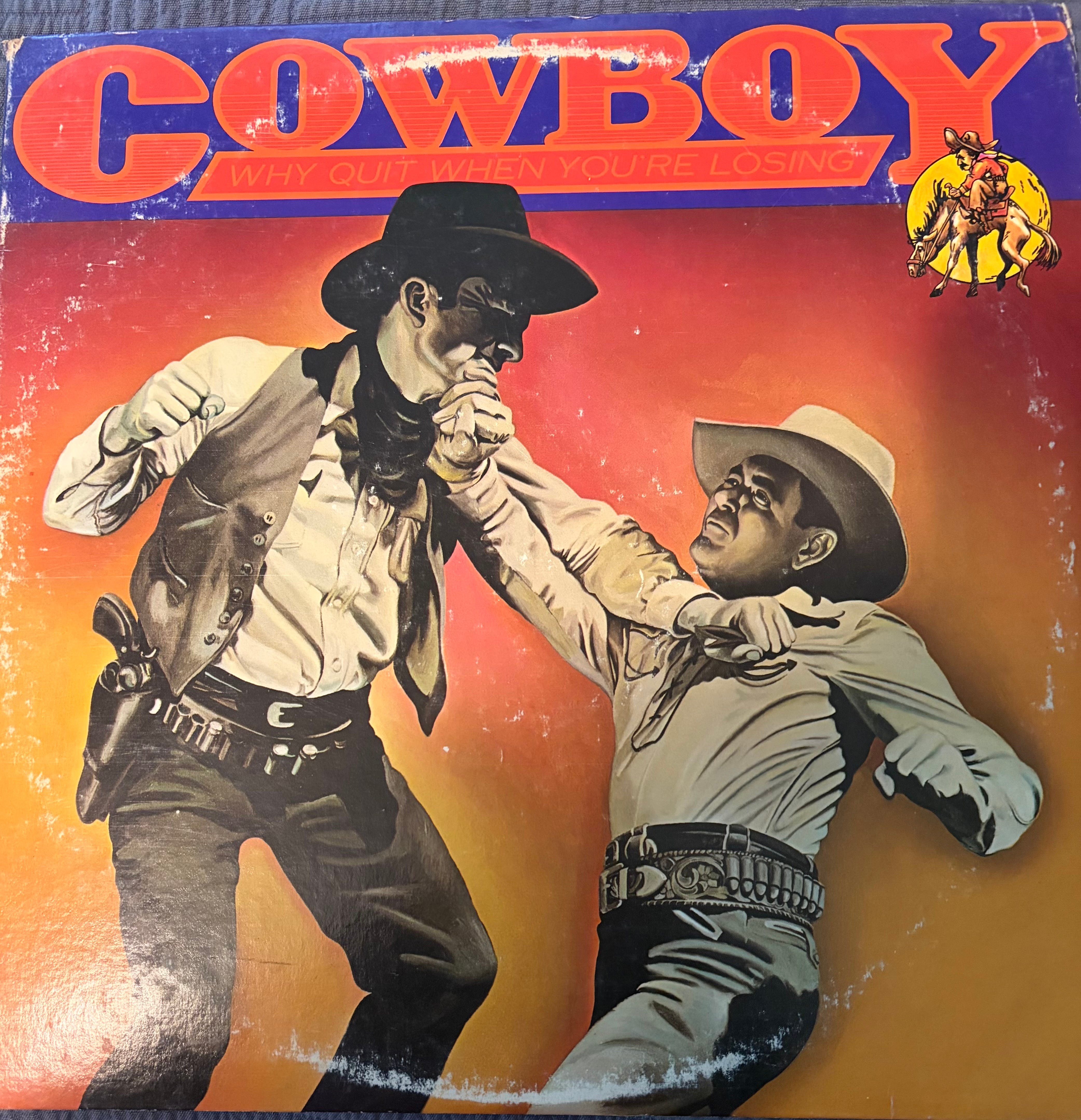
Me, I remember a lovely old tune entitled “Songs of Peace and Love,” written by C.S. Boyer, by what was even back then a semi-obscure band called Cowboy, but last night I heard “Guillotine” and “Seek and Destroy.” And I know well that yesterday started out with “Row, Row, Row Your Boat,” the audience was an almost impossibly cute 27-month old, the venue was the backseat of a car, and her admission was free; but the day ended with some Mongolians screaming at us and hundreds of head-bangers at the Fillmore who paid $84 a pop for the privilege. How did we get from “Songs of Love and Peace” to “Seek and Destroy”? How did my wife and I get from “Row, Row, Row Your Boat” to ersatz CPR last evening? Well, hey: You tell me, would you please?