
War Oops, War Hoops
Post-January 20, 2025 AoS Chronicle, No. 55

Things are kind of hectic these days of mid-June, what with school being out but parents still needing to work and so our house—Antebedlam, we call it, as TRP readers know—and our garden (Chicken Belch Farms) are lately wild with scampering, snacking, and singing granddaughters. So I intend a shorter-than-usual post, but with lots of photos for your harmless entertainment.
I am also sunk in the petty bureaucracy of a possible homeowners’ insurance claim since on June 6, when we were in the Philly area, a chunk of an old red maple fell in a thunder- and windstorm, missing our den for the most part but smashing a piece of white picket fence and incising two tennis ball-size holes in the roof that penetrated shingle, Tyvek vapor barrier, and plywood. No damage on the inside of the room, gratefully.
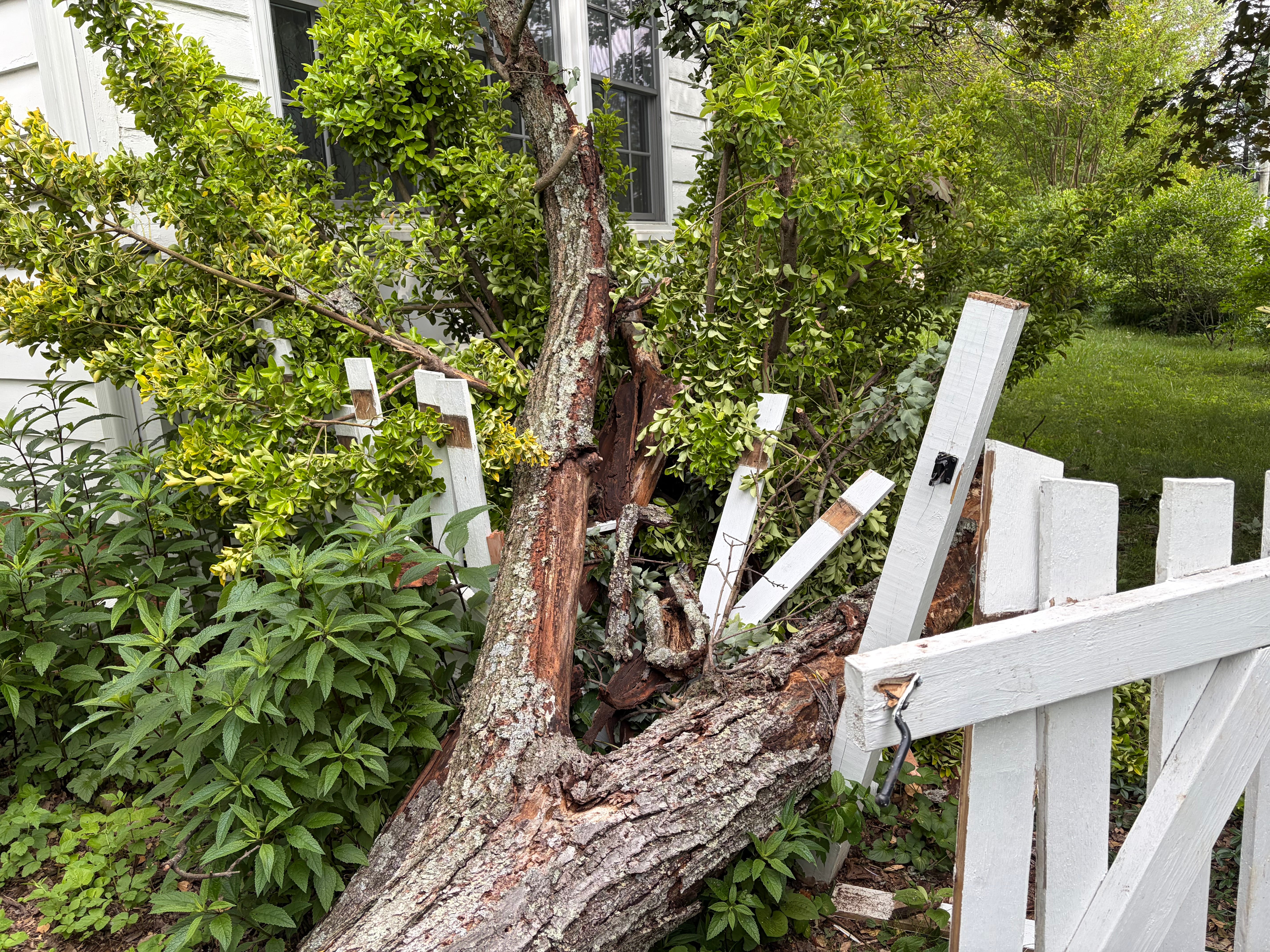
The company that put the roof on seven years ago seems to be no longer in business, so I’ve had to search for a roofing company that’s honest, and that doesn’t hire predatory sub-contractors to do inspections and who insinuate themselves, or try to, into your relationship with your insurance company so they can participate in what amounts to gray-legal insurance fraud. Yes, that actually happens sometimes, or tries to. More monkey business, n’est-ce pas?
Taking care of the fence repair and rest of the tree won’t be problematic. Alas, it’s just time for the tree to be taken down to make way for, hmm, let’s see, maybe the kind of cherry tree you can harvest for making pies, like one we had when we lived in Bala Cynwyd. We have a tree guy who’s a family friend; he used to work for the Parks & Recreation outfit here, where Scilla once directed a nature center. He’ll take down the trunk and ground out the stump, the hard part of the job, and I’ll cut, split, stack, and get rid of the leafy debris. I need the exercise.
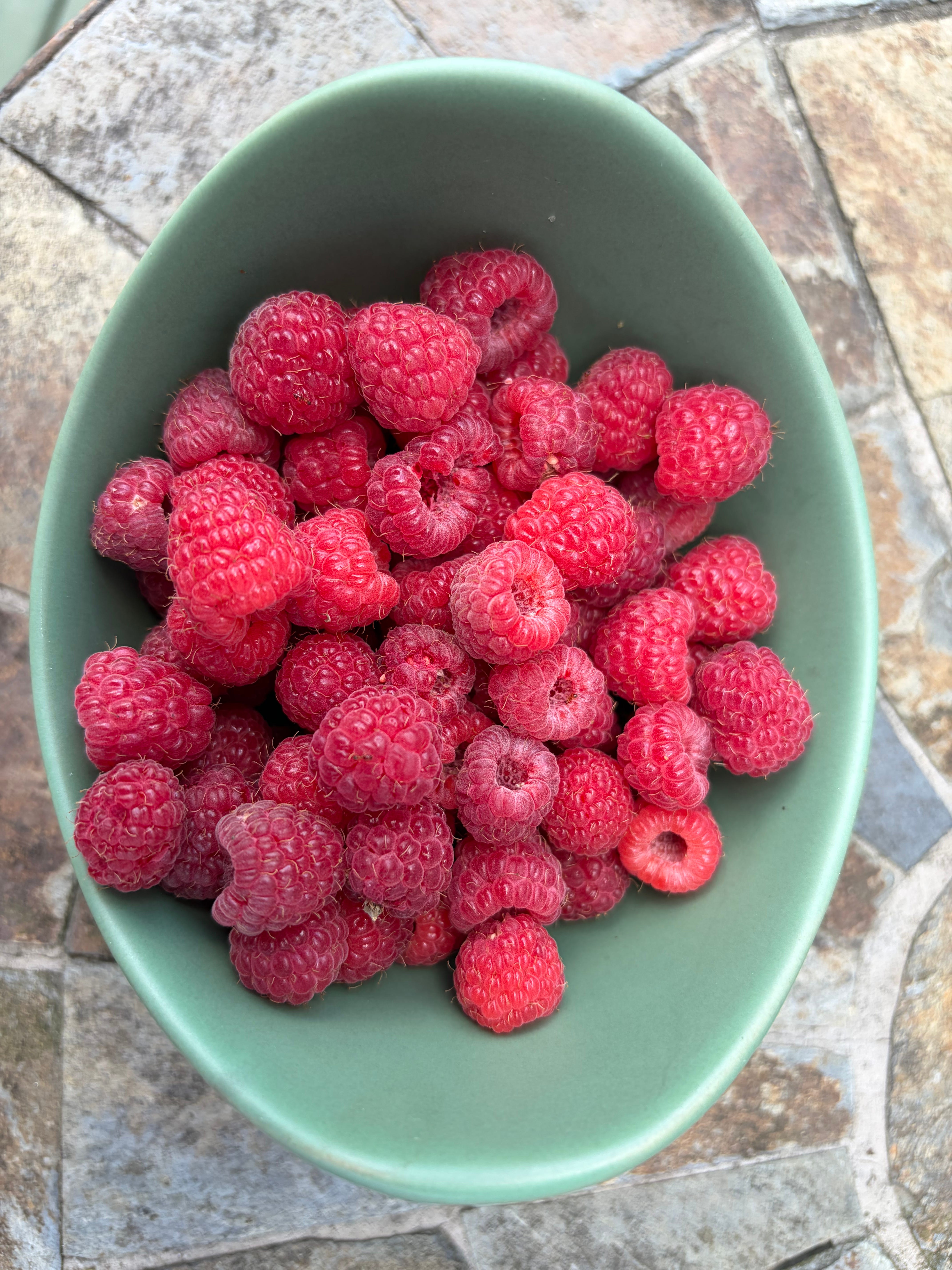
The garden, too, needs a lot of tending as the solstice approaches, including harvesting, which just recently has begun to include raspberries, bush beans, and even one early-bird banana pepper. And that’s beyond the mustard green, kohlrabi, chard, and kale rabe we’ve been eating steamed with tiny bits of sesame oil, pomegranate, and pink Himalayan salt—yum!—since mid-May. I’ve also in the past few days spot-planted beets where seeds didn’t germinate; same with parsnips, which are not easy to germinate in any case; same with four kinds of radishes after the first harvest. Busy, busy, busy….. So as I say, this will be short, with pictures.
**
So sure, as we all know, President Trump has finally got his “deal” with Iran. He got it on “deal” declaration number 39 after 38 declarations apparently spoken with a condom on his flapping tongue. The number 39 is three times 13, so we should expect three times the ordinary dose of bad luck. And we’ve got it: The 14-point agreement leaked via CNN (that may or may not be the final text) to be signed in Switzerland on Friday shows, as by now dozens of commentators have already declared, is the most profoundly screwed pooch of a negotiating outcome any of us has ever seen.
Now, a few commentators in recent weeks have risen to defend Trump’s Iran War, not least my former boss (for just about five months…) Condi Rice in the June 3 Wall Street Journal. Her enthusiasm was a bit conditionalized, but over all it reminded me of something I once heard Jesse Helms say to a witness in the Senate Caucus Room during a Foreign Relations Committee hearing: “So you’re sayin’ that for a fat lady she don’t sweat much.”
But Condi and a few scarce others aside, now that the “deal” seems inscribed in its 14 points--we can already hear the bad joke: God needed ten points, Wilson needed 13 (Walter Lippmann, really), but Trump needs 14?—the vast majority of reliable commentary is on the same wavelength: This is bad, really really bad. War oops, in other words.
If I just go down my email in-box I can readily collect descriptive phrases like “The U.S.-Iran Deal is Basically American Surrender” (Arc Digital), “Unconditional US Surrender” (Larry Kotlikoff), “Trump’s Iran ‘Deal’ is a Giant Bag of Dog Sh t” (Jonathan V. Last at The Bulwark), “The Art of the Non-Deal” (Frank Fukuyama at Persuasion), and plenty more. They all say more or less the same thing: This is just an MOU mainly focused on opening up the Strait of Hormuz within thirty days of signing, not a “deal” on the important issues; it’s impossible to negotiate the important stuff in the stipulated sixty days seeing as how the JCPOA signed in 2015 took nearly two years to negotiate; in his desperate search for an escape hatch Trump gave up on sanctions including presumably secondary sanctions; he agreed to fork over $300 billion to Iran, whether indirectly or directly makes no practical difference; he agreed to unfreeze Iranian assets; the MOU text pledges the United States to withdraw its forces from the area of the Strait, without specifying which forces, or whether they may include U.S. personnel in the Arab Gulf states; Iran can keep its nuclear program and uranium stockpiles of various enrichment grades, for now, pending a follow-on negotiation—all in return for an unenforceable pledge that Iran will not build a nuclear weapon, a pledge Iran has made before even as it worked sub rosa toward, yes, building nuclear weapons. Fool me once, shame on you; fool me twice, well, you know how that one ends, don’t you?
Virtually all commentators also agree that this “deal” is worse by far than the JCPOA that Trump denigrated and walked out of in May 2018, but a straight-up comparison of terms misses the starkly differing contexts between the situation as it stood in 2015 and the situation as it stands today. In 2015 Iran’s huge, busily operating nuclear complex was probably within months of building a bomb—presumably a bomb deliverable by airplane, not missile. (Too many casual observers make the mistake of assuming that nuclear weapons have to be delivered by long-range missiles, as was mainly the case in the U.S.-Soviet strategic competition during most of the Cold War; but in the Middle East distances are such that delivery by airplane makes far more sense, especially in light of how very much more difficult it is to marry a miniaturized warhead onto a missile bus than it is to just drop a fat gravity bomb out of an airplane bay.) President Obama’s choices were deal or war, and he chose a kick-the-can-down-the-road deal. The Iranians were some restrained by the JCPOA but could not help cheating anyway, and by so doing they eventually, a decade later, brought upon themselves the attack that the weapons program was ultimately designed to deter. Even a well-kicked can eventually stops rolling. Today, thanks mainly to that June 2025 12-Day War, Iran is nowhere near being able to enrich uranium or fabricate bombs--because the military operation Obama avoided in 2015 has since occurred.[1]
This is also why the complaint that the nuclear issue has been back-loaded in the negotiations sequencing is overwrought. Obama needed a deal in 2015 to avoid some very risky business in a political environment not conducive to winning and keeping strong domestic support for a war; Trump, and even the next President, is under no such urgent pressure to negotiate a nuclear deal. Yes, specifying just sixty days to negotiate a nuclear deal is sort of ridiculous, but it’s also not particularly important. The pressing need of the moment has been to get the Strait open and working again, not to staunch an Iranian nuclear program whose status right now is essentially inoperable due to tons of occluding rubble.
All that said and hopefully clarified, to the side of the MOU, commentators are picking and choosing what we used to call in old SALT negotiation days impacts “outside the four corners of the document”—in other words, what the negotiation and the context within which it rests say about larger forward-shadowing issues of reputation, intent, and credibility. None of what anyone has had to say so far, to my knowledge, includes anything sensible or significant that we have not already covered here in TRP in previous essays on the subject.[2] It would be tedious to review all the main points in six or seven (depending on how one counts) long-form essays written since early March; for the sake of relative brevity, let me just hit fairly lightly on a few main points and in so doing eschew any claim to a comprehensive analysis.
First, pace Condi, while Iran’s military and economy have been seriously dusted by U.S. and Israeli attacks, the Iranian regime is not weaker because of the war; it is, over all, stronger domestically, stronger in the region, and stronger in the world (partly for having been shoved toward the Chinese by recent events). It has demonstrated that it can close the Strait, causing enormous pain and anxiety far and wide, and that, as Ayatollah Ruhollah Khomeini famously said in November 1979, “the American can’t do a damned thing” about it except bluster and waste ordnance to the tune of more than $30 billion. It has proved, yet again, that the balance of interests is more important than the balance of power, and that the willingness to endure pain is what usually defines the winning hand in set-tos between great powers going abroad in search of monsters to destroy and determined regional actors.
More, the Iranian regime will own the water in the Strait and extract cash from passage in the future, whether the cash is called a toll or something else, and the previous international legal status of the waterway is now shredded. The new leaders of the Islamic Republic, their elders mostly assassinated by Israeli strikes, are less tainted by corruption, for now, they are more pragmatically nationalist than mystically religious, and their murderous wrath is more feared by regime opponents and ordinary Iranians than ever before. They are also, perhaps, a good deal more likely to be plotting revenge terrorism on U.S. soil, even as U.S. counter-terror capabilities are lying stagnant as the FBI focuses on attacking the critics of the President’s ever-expanding enemies list.
Most important on this point, Iranians—Farsi speakers who make up about 61 percent of the population, and perhaps particularly others—are drawing closer to the conclusion that if a massive joint U.S.-Israeli attack on the regime cannot destroy it, then nothing can. That is a conclusion conducive to greater political resignation and passivity in the future. That does not mean that the Islamic regime may not eventually fall; all mortal things come to an end, after all. But the war has most likely pushed that date further into the future than it otherwise would have been.
Second, we have stressed in earlier TRP essays that Iranian negotiating strategy managed to do two clever things simultaneously. It exposed the contradictions between the Israeli and the U.S. interests in the war, and leveraged Trump’s political desperation to get out the mess he stepped in by pressuring Israel to relent in Lebanon and thus save what is left of Hizballah’s arse—thus in turn causing, as things seem to be turning out, the largest rift in U.S.-Israeli relations since the days of Itzhak Shamir and George H.W. Bush (for those who remember ancient history). And it also put opening the Strait at the top of the negotiating agenda and relegated the real core issue, Iran’s nuclear program, to the to-be-discussed-later rear—though, as already noted, that is less of a big deal than some are making it out to be.
This first achievement merits an additional note. Back in the 1980s support for Israel was deepest among Democrats in the United States, though it is fair to say that it was bipartisan to a considerable degree. Since then, three things have changed simultaneously: Benjamin Netanyahu, almost single-handedly, managed to shove the Democrats to the side in favor of GOP support for Israel (let’s spare ourselves the details of how he managed this, aside from once bumptiously addressing a joint session of Congress against the expressed wishes of the White House); Israeli policy under mostly Revisionist Zionist leadership drove Israeli political culture to the right, away from Israel’s original socialist ethos and membership in the Socialist International (and vice-versa, too, of course, the culture also driving the politics); and the Democratic Party as it churned a generation became not just outflanked by Republicans in support for Israel but grateful for being displaced as younger Democrats grew to dislike and disparage Israeli behavior toward the Palestinians. The result is that Israeli hopes for U.S. support now have nowhere to go. Support won’t come from Republicans as long as Trump is around but there is no way to pivot back to the since-shifted Democrats. Up shit’s creek, in other words, no Republican paddle, no Democratic paddle…..no paddle at all. Bibi didn’t “achieve” this all by himself, true. Just nearly so.
Third, we stressed in earlier analyses the morbid counter-proliferation implications of what has happened. But now those implications are even starker. “Get a nuke if you don’t want the Americans to attack you” was the conclusion in the weeks after February 28. Now the conclusion of many by-standing nations will be “get a nuke and don’t worry too much about the Americans attacking you if you have any counter-leverage at all worth speaking of,” because they are, in this Administration at least, a bunch of clueless, feckless dickheads.
And fourth, there is the war’s de facto advancement of the nexus between Chinese global financial aspirations, matched to Chinese economic clout, and the now endangered petrodollar arrangement put in place in 1974 between King Faisal and Henry Kissinger. That arrangement established a cycle of dollar-only denominated oil sales recycled into U.S. Treasury paper that has ever since, with a bit of burnishing here and there, enabled the U.S. Government to borrow skeezads of money at the lowest interest rates available to prop up its Rube-Goldberg excuse for sound fiscal policy. (Few are aware that a cousinly clan of the oompah-lumpas has for decades been secretly beavering away in the basement of the Treasury Building just to keep this contraption from falling into scobs and flinders.[3])
Few Americans are aware, as well, of how this cash recycling machine has worked all these years, but in league with the accountancy antics approved by the Congress that have wrecked havoc with budget sanity—between what is “on the books” and what is artificially “off the books”—we now approach an unsustainable national debt of $40 trillion and, if the Chinese and others succeed in subverting the petrodollar-Treasury paper money-go-round, a sudden and near total tanking of the solvency of the Social Security system, and Medicare with it. Then a lot of Americans will retrospectively become aware, after a fashion at least, of the shenanigans of the past several decades, after the whole crutch of fiscal self-deception plummets over the waterfall of economic history into the dark lagoon of brilliant schemes that used to be (like the Hanseatic League and the kindred Chola Empire, but this we mercifully will not pursue for the time being).
The multidimensional strengthening of the Islamic Republic, the eruption of possibly the most serious and consequential rift in U.S.-Israeli relations since Suez, the stimulus over time of more WMD proliferation in some parts of the world least likely to model restraint once those weapons are acquired, and the possible advancement of a domestic economic earthquake in the United States in a post-petrodollar cycling era—these are the four main “outside the four corners of the document”-effects of this disastrously misbegotten war. Some commentators, looking up from the tyranny of their presentist self-imprisonment beyond the expected MOU signing on Friday, have mentioned some of these four major effects of the war. Perhaps some one or two have mentioned all of them in the same piece of writing. But if so, I’ve not seen it. No one can read everything these days…..
Is that all there is to say? Of course not. In the Trump 2.0 era amusements of the gut-curdling kind never cease. Let’s briefly note just three recent examples.
The other day the President said that Iran should be able to keep some missiles because the countries around it have some. He said this publicly, offering up a totally naked diplomatic freebie. He still is unaware, evidently, that Iran lacks anything like an air force; he thinks, since he said it at the G-7, that U.S. forces destroyed the Iranian Air Force in the war, but you can’t destroy what doesn’t exist. Iran’s missile program thus has to function as an operational and deterrence factor vis-à-vis other regional powers’ air forces. That said, essentially dropping the matter of Iran’s missile program, if that is what Trump is implying, rather than seeking to discuss numbers, payloads, and ranges, represents a major concession for which the U.S. side appears to have gained approximately nothing in return.
The next day, I think it was, the President opined that Syria might be able to play a useful role in Lebanon, presumably in dealing with Iran’s Hizballah proxy, “if Israel cannot do the job without killing everyone.” So reported Ha’aretz on Tuesday. Trump has not been wrong to criticize Israeli tactics in Lebanon, but the idea that a Sunni-led Syria can and will come to Lebanon’s rescue has to evoke a kind of graveyard humor among Lebanese with any memory at all of the post-1975 period. No doubt some oldsters in Tripoli are now pulling their old Murabitoun gear and regalia out of their footlockers, just in case. (Most TRP readers will likely not get the reference here to the old Sentinels fraternity, sorry. But you could look it up, you know…..)
Thinking of Syria as a useful adjunct to a sensible and constructive U.S. policy in Lebanon is a bad idea, but it may well be a less bad idea than other available worse ideas. That is where we are; this is the Middle East we’re talking about, right, so what did you expect? Lebanon has been a kind of Levantine punching bag for marauding outsiders for way too long, going back all the way to Ottoman times in point of fact. If the post-November 1943 independent Lebanese want to screw up their country again, at the very least they should be accorded the right to do it by themselves. (Fat chance.)
Last for our humor section, let us mention in quick passing President Trump’s, um, remarks to the G-7 yesterday. As others have noted, he took a more realistic tone to the American dilemma in the war than heretofore, but that does not suggest a less braggadociotic personality, only a re-aimed one. The President’s press conference turned into a now-typical perpetual parenthetical mumble. The “deal” sent the stock market soaring, and the price of oil plummeting and Qassem Suleimani who “I killed” was a mad genius who was never replaced and we have had regime change in Iran and if I, Donald Trump, had not left the JCPOA Israel would have been terminated by now along with the whole Middle East, and Herbert Hoover raised taxes, and I spoke with President Putin and…..and he rambled on like this for 35 minutes before taking a first question from ABC News which he labeled “fake news” before the question was even asked.
Trump’s G-7 monologue nearly matched in aesthetic grace the June 14 U.F.C. cage match in front of the White House on his 80th birthday. Only one significant difference separated the two presidential events: The U.F.C. match, no matter how vulgar and debasing of the presidency it was, at least gave off a whiff of reality. Its violence and calculated cruelties were real, sort of. Contrarily, Trump’s G-7 remarks more resembled a spewing fountain of delusional magical-thinking verbal diarrhea. Never in the history of the American presidency has a foray into international diplomacy been as accidentally disastrous as this one was; never has so much reputational capital been dumped over the side of the ship of state so fast and furiously. Why do I rank this as humorous? Because not to laugh at something so far beyond the normal parameters of belief is just too painful.
**
You may not believe it, but I never set out to write today about the “deal,” the Iran War, or anything related to it. It just sort of popped out. But now that it’s out, I’ll leave it be, and quickly get on to what I really had in mind to tell you, something more important than anything having to do with the Iran War and its apparent denouement, which circles back to the homespun and personal.
Brookside Gardens here in Montgomery County, Maryland has in recent years taken to hosting four free outdoor concerts on Tuesdays in June. This past Tuesday we again assembled in the grass with picnic supplies at the ready, with friends and families all around, on a pellucidly beautiful late springtime afternoon.
I decided to wear my most provocatively political t-shirt to the concert. I did so partly because the band for this concert was about to play generic Hispanic dance music, and I wanted to at least gesture in a small way my moral support to legal immigrants (like all four of my grandparents from eastern Europe) in the face the Greg Bovino-style “heritage American” fascist core in the current Administration that would expel, by Bovino’s own count, 106 million residents of this country, the vast majority of them entirely legal but of brownish skin hue, if he and his ilk could get away with it.[4] Some have gone so far as to include Native Americans in the group of people whose citizenship would be revoked and sent packing since, after all, their skin tends to be too dark for the Bovino et al. aesthetic. That has really set me off, boiled my blood--hence my choice of sartorial display.
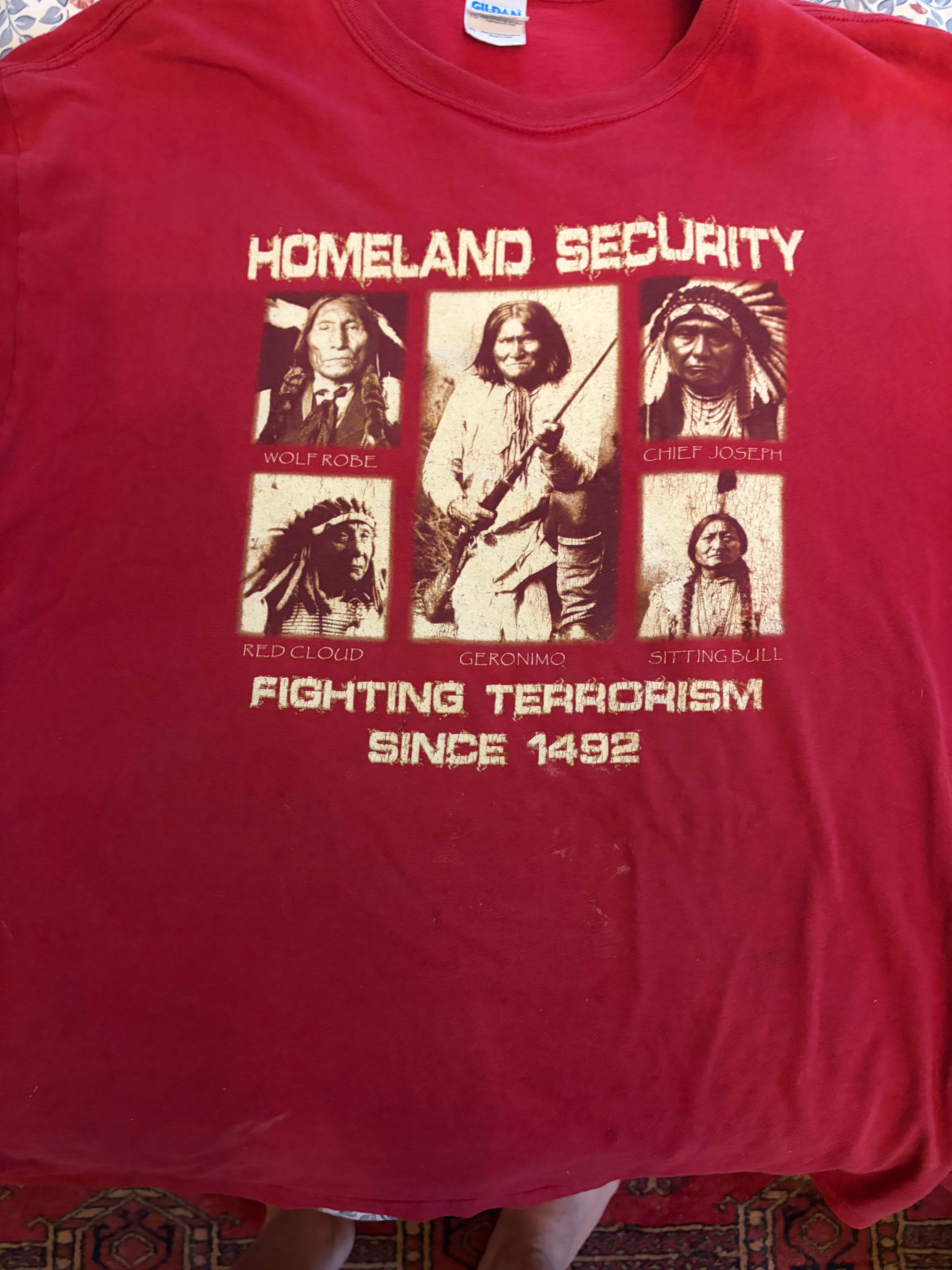
I had been thinking, too, again, about the deeper demons in American history, and about how and why they manage to manifest decades, even centuries, later. Back on February 11, 2025, in “White Magic at the National Archives”: Post-January 20 AoS Chronicle No. 1, the only post I have ever set aside for paying subscribers, I wrote the following:
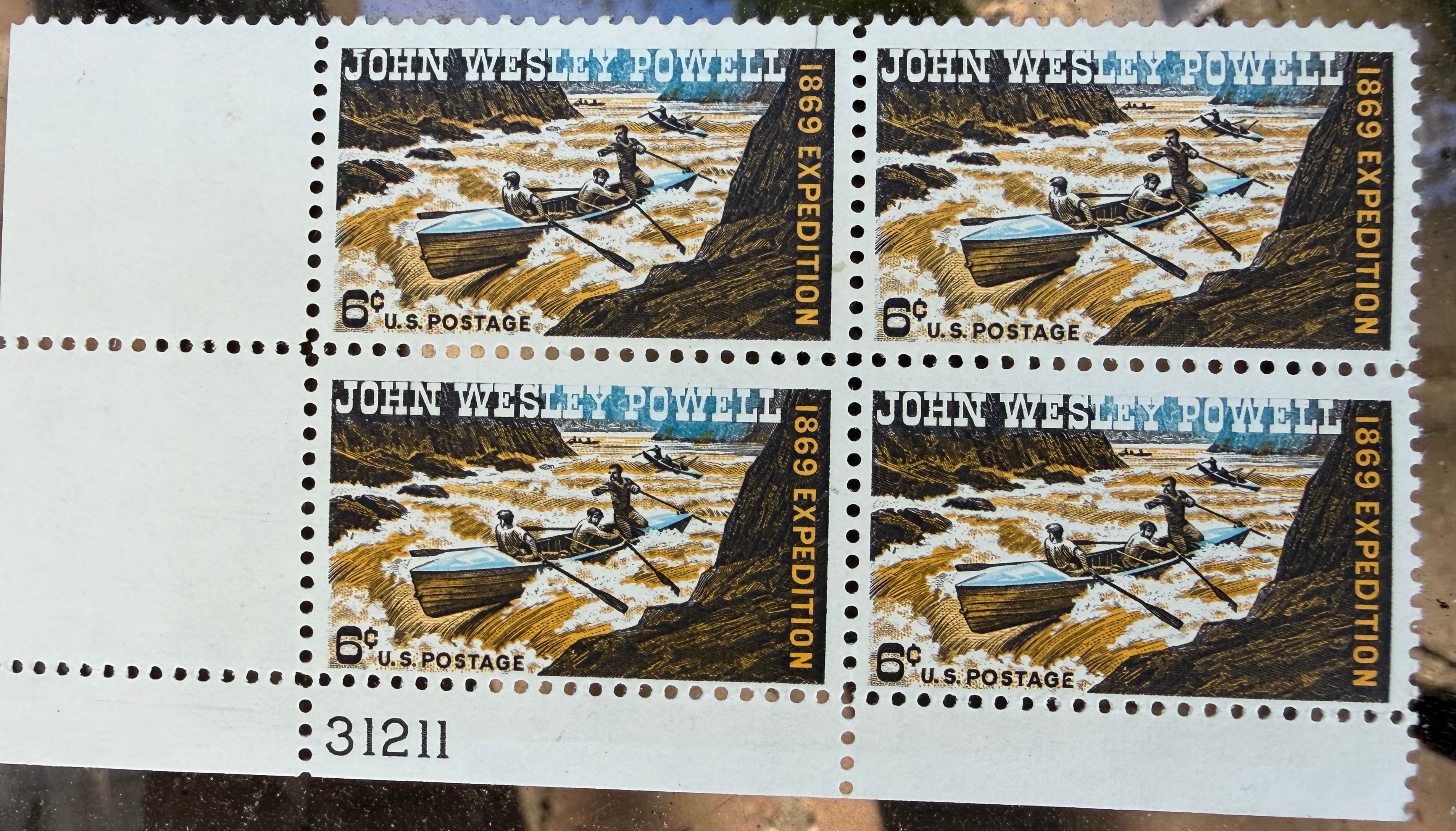
The American historical imagination still venerates Kit Carson, for example. The original prooftext for Carson’s supposedly heroic exploits is the once widely read John Wesley Powell book The Exploration of the Colorado River and Its Canyons (1895). But if you read what Carson did to subdue the Navajo, which Powell relates in relishing detail, it reveals what today we would today call state terrorism and certainly would qualify as a war crime. Yet as recently as 1994 the USPS put Carson’s face on a postage stamp.
If Kit Carson can still be a hero, if aggressing against Canada, Denmark, and Panama can be popular, if word-magical votive acts like the re-naming of mountains and gulfs of water can actually seem like something significantly real to many people, then—again—why can’t falsifying the official record of the November 2020 election succeed? (N.B.: And why can’t subverting future elections also succeed?)
So you see, then, what is really at stake in the world of Trump 2.0. It’s not just a range of critical policy decisions with life-and-death implications for people here and abroad. It’s not just the status and future of the Constitution and the rule of law. It’s not mainly about the physical security of Donald Trump’s real and imagined enemies. It’s not the now hazy future of the constructive role of the United States in the world. It’s the status of reality itself: past reality, and therefore present and future reality.
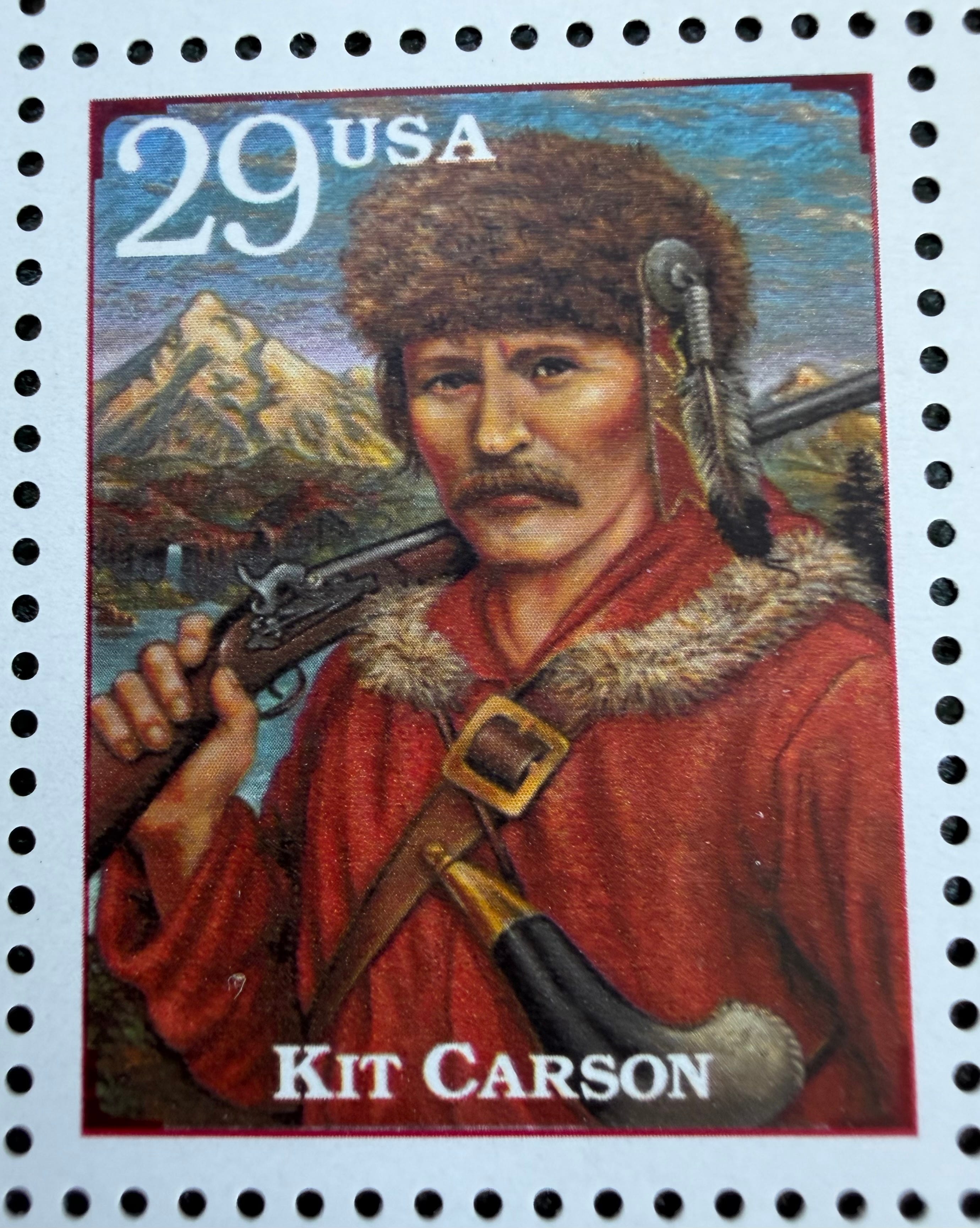
So we have to take people like Greg Bovino, and those who hired him all the way up to the Oval Office, seriously, these people who come right out and tell us who and what they are. Despite obviously different contexts, ICE and Border Patrol marauding, intimidating, pushing and punching and even murdering people in Minneapolis this past winter had far too much in common with Kit Carson and his frontier domestic terrorists back in the day for comfort: the gratuitous swaggering, the obscene dehumanizing language, the wanton cruelty, the xenophobia, the racism, and above all the proudly willful ignorance and disdain of empathy about the people whose lives get turned into targets of unalloyed hatred.
We had to leave the concert in mid-performance, with youngest son and 28-month old daughter, because little Joni had danced herself, with her cousins and friends up on stage, into a pre-slumber funk so deep that she had reached up and removed her cochlear implant gear to get a little peace and quiet. So we packed up our bags and gear and headed toward the parking lot. I trailed the others, carrying a fold-up chair, its stuff-bag, and the last tote sack of half-eaten picnic fare when, just to the right of the stage as I egressed the concert, a dark-haired woman in maybe her mid- to late-40s came up to me, smiled broadly, and said, “I like your shirt.” I replied, “Well thanks,” and before I could say anything else she offered: “I’m an Apache, from Arizona.”
I regret not getting her name and POC information, because I sense she has stories, and lessons, I want to hear; I did manage to say that “I wore this shirt today because, despite the different contexts, I see troubling similarities between the Trump Administration’s behavior toward people of color and what happened to Native Americans many years ago, not least to your linguistic cousins the Navajo at the hands of Kit Carson and others like him.”
“Of course,” she said quietly: “Why don’t more people see the connection?”
“I don’t know,” I answered her truthfully. I smiled, and set off to catch up with my wife, son, and youngest granddaughter. I hope I see her again, at the next Tuesday Brookside Gardens concert. I have questions to ask.
Now dig this: Listen to the words, and understand please the inner core of what is really important in American culture and politics today. It’s not a stupid war.
[1] This distinction is clearly articulated in Michael Singh’s New York Times essay “Trump’s Iran Deal Isn’t Perfect. It Doesn’t Need to Be,” in today’s paper.
[2] Here they are, from most recent on back, for those who may wish to consult the archive: “Jaw, Jaw Better Than War, War?” Post-January 20, 2025 AoS Chronicle, No. 53, June 3, 2026; “When Is a Peace Deal Not a Peace Deal? Whenever Donald Trump Says It Is,” Post-January 20, 2025 AoS Chronicle, No. 52, May 26, 2026; “The Three Faces of the Iran War: A (Short) Study of Multiple Political Personalities,” Post-January 20, 2025 AoS Chronicle, No. 46, April 14, 2026; “Literacy, the New Orality, and War,” Post-January 20, 2025 AoS Chronicle, No. 46, April 1, 2026; “From MAGA-look Cosplay Porn to ‘War Porn’: Behind the Iran Front,” Post-January 20, 2025 AoS Chronicle, No. 44, March 18, 2026; and “The Amateurs’ War, Part 1 & 2,” Post-January 20, 2025 AoS Chronicle, Nos. 43A & 43B, March 9, 2026.
[3] One of my favorite expressions from Charles Frazier’s Thirteen Moons (Random House, 2007), p. 344.
[4] See Bovino quoted in Jonathan V. Last, “Nazis, Real and Imagined,” The Bulwark, June 6, 2026.