
El Golpe Norteamericano en Venezuela, What It Means--Updated
“Post-January 20 AoS Chronicle”, No. 34S

The Venezuela business being what journalists call “a developing story,” I’ve decided to break normal schedule and offer TRP readers an update now, at T+3 days. What follows is different in four ways from the December 5 original: (1) it fixes a few typos and repairs a feeble, rushed, and off-centered attempt to bring Friedrich Nietzsche into the discussion; (2) it makes mention of some things that have happened since December 5, not least Stephen Miller’s CNN interview with Jake Tapper; (3) it displays some new and I think usefully vivid language; and (4) it adds a question and answer to the Q&A section.
If you did not read the original, good—this is better. If you did, you may or may not want to invest more time in this—up to you, obviously, and it’s no skin off my ego one way or the other.
Harding and Trump
Speaking of then-newly elected President Warren Gamaliel Harding, H.L. Mencken famously wrote that Harding had
. . . the worst English that I have ever encountered. It reminds me of a string of wet sponges; it reminds me of tattered washing on the line; it reminds me of stale bean soup, of college yells, of dogs barking idiotically through endless nights. It is so bad that a sort of grandeur creeps into it. It drags itself out of the dark abysm of pish, and crawls insanely up the topmost pinnacle of posh. It is rumble and bumble. It is flap and doodle. It is balder and dash.
Now, Mencken was writing of a President who followed one of the most highly educated men ever to occupy the Oval Office, the former President of Princeton University, Woodrow Wilson. Wilson was an inspiring and eloquent speaker, which of course did not make him any less a vile racist and an unreconstructed idealist racing his good intentions pell-mell on the road to hell. And Harding, as a plain-spoken Baptist and Marion, Ohio native, was not. But for all of Mencken’s inspired effort to douse Harding with the stench of eternal expressive rot, he sounded like Demosthenes compared to second-term Donald J. Trump. The difference, however, shows more in what the two Presidents have said than in how they have said it.
Harding was 55 years old when he was inaugurated as the 29th President; Trump was 78 years old on January 20 of last year. That 23-year differential may account for part of the variance, but not for most of it. Harding, being who he was because mostly of being when and where he was, was a decent if somewhat shallow fellow who believed in Abrahamic virtue as reckoned by its discounted translation into Protestant Christianity. He believed in honesty, in integrity, and in truth even when his own behavior failed to measure up to his ideals. Donald Trump believes in no ideals, has no ideals. Like many other non-readers his world is schizophrenically split between the concrete and the otherworldly—in his case between the dirty-fingernail vicissitudes of power and the sirens of conspiracy theories. In the vast middle of human social life formed by conceptual and metaphorical framings Trump is a lost child in a threatening fog of suspected but unfathomable meaning.
Like his Vice-President, Trump considers ideals to be a part of that great swath of conceptual reality, nested within what Charles Horton Cooley called in 1897 the “social mind,” that has always evaded his grasp as “moralistic garbage.” Trump is thus perhaps the best (probably the second best), and the purist example ever born and come to be widely known of Friedrich Nietzsche’s inversion or transvaluation of morality, restoring the “good” of life-affirming value to aristocratic power, wealth, pride, and sensuality, and overturning the evil slave-morality of Christianity that values meekness, humility, and even suffering. Trump’s example is pure because it resembles the not yet (in his case not ever) intellectually adumbrated mind of a literate adult. (He certainly did not come to his views from a close reading of Nietzsche’s 1887 book On the Genealogy of Morals.)
Beyond lacking ideals, Trump also has no ideas, merely emotionalized mental tics masquerading as ideas—as Lionel Trilling once put it in a different context. What he does have are deep needs engraved in his psyche from childhood trauma, and long-woven fantasies designed to fulfill or palliate those needs. What we see, then, is a mentally damaged nine-year old heirhead who is coincidentally a malignant narcissist with a fantasy-prone personality type tacked on, and who is today likely the victim of both a fairly recent mild stroke—so say most competent observers of Trump’s asymmetrical facial sag, his right leg swing-stepping, and his increasingly frequent spells of spatial disorientation—and of advancing dementia.
No, I am not a victim of Trump Derangement Syndrome, like poor Rob Reiner accusedly was. I do not hate Donald Trump or wish him dead. I sympathize with his multifaceted illness and wish for him, beyond the presidency as soon as possible, the best medical care his mostly purloined billions can buy him. I see reality as best I can without ideological blinders—once well described by Guy Debord as “the dictatorship of illusion”—or sacks of recreational drugs.
He, not me, is the one who is deranged, mostly through no fault of his own. He is the one I have described as being like Harold and his Purple Crayon, creating his world from his own imagination of it, just like any good fictional phenomenologist should, except that in Trump’s case it’s the Purple Crayon from Hell trying non-fictionally to displace the entire Lebenswelt with a fantasized two-dimensional reality-TV world where wrong is right, real is fake and fake is real, and Trump himself is an impossible cartoon-Christ-like combination of greatest hero and most afflicted victim ever.
Is that enough to explain how it has come to be that the essential framework of American politics today is per force—words chosen carefully—based on a monstrous and completely unsupportable twin Big Lie about November 5, 2020 and January 6, 2021? Absolutely not; no, it isn’t. Were it not for the apparent major-sized hordes of postliterate, poorly educated, entertainment-besotted, cyber-addicted and hence perpetually distracted, and so vulnerable to silo-sited infotainment brainwashing, Americans who exercised their franchise in November 2024—and before that less guiltily in November 2016—Donald Trump would be today what he always was: an eccentric greedy rich bastard of no special talent or interest.
Trump, launched into the world from a cannon of pathological parental infusion, turned out to be an idiot-savant. His special showman-shamanistic power, tutored early on by master Vince McMahon, has resided in his preternatural intuition of how to extract attention, fealty, and money from what the odious Scott Adams once called “moist robots” in a digitized and hence surrealized media environment. But no moist robots and no surrealized media environment, no President Trump with his Purple Crayon from Hell wreaking highly imaginative havoc on what remains or remained, as the cases may be, of both the U.S. domestic liberal democratic order and now the ultimately Enlightenment-based global liberal international order. We otherwise would never have learned of his special talent, nor possibly even of his idiocy.
Well, lest I be plausibly accused of ducking a sensitive issue, it is true that an additional causal factor has made this batshit crazy moment possible: the gobsmackingly full-frontal incompetence of the Democratic Party. That once responsible party pissed away its critical traditional support among organized and even not-so-organized labor in favor of waging exotic-genitalia culture warfare that has proved so decisively off-putting to most Americans as to constitute the source of the greatest political negative follower effect since the radical phase of the Vietnam antiwar movement. In two of three electoral contests it sent finger-wagging, down-bridge-of-nose glaring women against the faux-Alpha male Trump at a time of thymotic male obsessiveness in a post-heroic age of gray technocratic tedium. Brilliant…..
And so we come, finally, to El Golpe Norteamericano en Venezuela. But you see, dear reader, if you do not understand, or finally admit, who and what Trump is, and pretends to himself to be, and if you do not understand the deranged surrealist environment in which he wields his Crayon, you cannot really understand anything about what has been transpiring these past few days between the U.S. and Venezuelan governments, and all the heaves-and-hos of other interests caught up aware and unawares in it.
I’ve no intention of trying to relate here details of what has happened, or to offer any sort of comprehensive standard geopolitical or geoeconomic analysis, let alone to predict in any concrete way where all this will lead. So much inadvertent self-parody and farce is involved, on nearly all sides as best I can tell so far, that to project rational consequences from it would be roughly comparable to acting on the basis of real estate advice from Paul Bunyan.
Nor am I going to comment sideways on what other commentators have been saying, except to make or illustrate a particular point. Nor will I analyze how the Venezuelan intervention is being treated by the commercial broadcast talking-heads media, or on social media—because I don’t know. My doctors have told me to avoid gratuitous stress, so involuntary volcanic outrage at knuckle-dragging ignorance, I infer, is something I should avoid. I take their point, and obey—mostly. The other night, Saturday night I think it was, I did overhear a retired U.S. General, working as a military commentator for what is actually a reputable outfit, say some unfortunate and misleading things. I will name no names to protect the guilty, but I will relate what I heard and why it made me regret having no single malt Scotch whiskey in the house.
Said retired General claimed that the population of Venezuela was about 90 million, and that it is a very big country, implying a country difficult and expensive to subdue militarily or otherwise. Horsefeathers and dragonsnot. The population of Venezuela is less than 30 million—no one knows for sure how many people are actually in the country, since years’ worth of the Maduro government’s tyrannical mismanagement of the economy has driven many millions to flee their homes for safety and succor abroad. So our expert commentating General was off by about 300 percent. Otherwise, yes, Venezuela is a big country, bigger than France and Germany combined. But 85 percent of the population lives in the country’s three major cities in the north—Caracas, Maracaibo, and Valencia—and in smaller towns and villages in between them. This means that not only is most of the country very sparsely populated and infrastructure scarce and relatively primitive as one moves into the interior, but that from a military point of view Venezuela is an island, since every significant target in the country can be attacked from the sea, directly and by dint of naval air power. Compared to both Afghanistan and Iraq, then, it is an easy territory to seize and control—not that I am suggesting we should do it!! But you take the point, presumably.
Look, unlike most of the talking heads we’ve seen on our screens lately I have actually been to Venezuela. That doesn’t make me an expert, and I don’t claim to be one. But I can at least read a CIA country handbook properly……
OK, Q-and-A, Compare and Contrast, and All that Jive
The only sensible way I can see to go about this task before us is by posing just a few strategically pregnant questions and offering suggestive but not definitive answers to them, because no such answers yet exist.
Is what we witnessed beginning on Friday night and passing through to the present moment truly an example of regime change?
No, at least not yet, despite what so many commentators are asserting, as they ramble on about the various challenges that inevitably attend U.S.-instigated regime change. We even have Democratic Party critics decrying regime change and global tyrant policing as if to throw mud in the eyes of MAGA faithful who were promised no such a damned thing during the 2024 campaign. At least some of them are doing something for a change.
The Trump 2.0 Administration has contradicted itself on this point, and that has seeded confusion. On the one hand the Administration has not flatly denied the description of regime change, and since Trump himself makes no distinction between leaders and regimes (true for Putin/Russia, Zelensky/Ukraine, Xi/China, MBS/Saudia, Netanyahu/Israel, and so on), it follows that snatching Nicolás Maduro from his home country qualifies as regime change. But the Administration also denies that the main motive of Operation Absolute Resolve is political; in its galactically hypocritical telling it is legal, so that the Delta Force Night Stalkers—great work, guys!—operated in effect as agents of the Justice Department, not the State Department or the so-called Department of War or even the White House, for that matter.
Moreover, the President twice stated that the United States will “run” Venezuela. And he added “we are in charge,” language that strongly implies the assumed overthrow of the previous regime. The language parsed carefully—“run” and not “rule” or “administer” or “govern”—shows that, as several observers (myself included) have pointed out, Trump sees himself as the head of a for-profit business corporation, having effected a hostile takeover of the U.S. Government on November 5, 2024, ratified on January 20, 2025. That’s the only kind of large organization he understands, so he is unclear about what regime change even means to him since he has trouble distinguishing private ownership from public authority.
A republican (small r) government in post-Enlightenment times bespeaks a social contract arrangement between demos and polis as mediated by law, and as a subset of law, by periodic elections. This is a description of an institutional arrangement that is necessarily redolent with abstractions and metaphors. As Michael Walzer once wrote:
In a sense, the union of men can only be symbolized; it has no palpable shape or substance. The state is invisible; it must be personified before it can be seen, symbolized before it can be loved, imagined before it can be conceived.[2]
As a proud lifelong non-reader, Donald Trump has trouble with abstractions and metaphors used in this way. As I have argued before, his mind is not anti-liberal or anti-democratic; it is pre-liberal and pre-democratic. Indeed, it is even pre-early modern; his profoundly concrete mind grasps personal power—monarchy is a good example—and so by extension he grasps zero-sum imperial spheres of interest, mercantilist trade habits and the uses of privateers (a.k.a. pirates) on the crown’s behalf. Were he cast in a remake of Robin Hood (no, not the “men in tights” version….) Trump would be Prince John the knavish usurper, and everyone working for him would be in effect the Sheriff of Nottingham. But he does not credit because he does not really understand government as an institution designed to serve the commonweal, or the state as the security and identity topcoat of that institution. Less even does he understand politics as an avocation of public service instead of a roost for the looting of the commonweal on behalf of his supporters, his family, and himself.
Now, since Friday Trump has not walked back his language about the United States being in charge and running Venezuela. Even starker, he has turned his regime-change vocabulary and attention volubly and somewhat madly to Colombia, Cuba (in a particularly passive-aggressive way), Iran,…..and Denmark! Interesting collection of governments, no?
Yet, on the other hand, the newly sworn-in President of Venezuela, Delcy Rodríguez, is in place as are all the other officials of the Maduro government, or regime. She claims that President Maduro and his wife have been kidnapped and that he is the legitimate President of Venezuela, this despite his having stolen the 2024 election and being in fact the head of an illegitimate non-democratic government. She at first gave no ground to the Trump Administration, though in subsequent remarks she seems to have softened her voice, no doubt for pragmatic reasons kindled by stark fear of what might happen next to her and her virulently anti-American Marxist friends. But she is there nonetheless, her colleagues are there with her, we have no functional embassy in Caracas and aside from some Chevron employees no real presence, official or otherwise, of any kind in the country. All the U.S. soldiers who participated in the special forces operation on Friday/Saturday are, as far as we know, not in-country now. We are clearly not in occupation of Venezuela therefore, and cannot impose our will as if by ventriloquism. Exercising naval pressure just offshore, trying to prevent oil exports even at the non-trivial risk of hunting and assaulting ships belonging to third nations (like Russia), and making threats is not tantamount to a controlling occupation. So from whence regime change? Gunboat diplomacy is not the same as regime change. It is, in essence, attempted piracy in pinstripes. (Into my mind’s eye flows—and forgive me, I just can’t stop it—an image of a nine-year old Donald Trump with his parents at the Coney Island arcade playing the Clean Sweep “claw” machine, and Donnie shouts out, “Look, Dad, I hooked Venezuela’s oil!”)
Secretary of State Marco Rubio seems to have grasped this evidential reality and at one point just the other day stated in front of journalists that the United States is not running Venezuela; he was immediately contradicted by Trump. Speaking of ventriloquism, this revealed the actual Edgar Bergen/Charlie McCarthy relationship between the President and his Secretary of State (and National Security Advisor, and head of The National Archives…and Rubio better be careful because if there is an opening soon he may also end up as Director of the National Zoo….).
Last on this point, Maduro claimed this morning in Federal Court in Manhattan that he was kidnapped, that he remains President of Venezuela, and that his government is still functioning. He also suggested to the court that he cannot be guilty of violating U.S. laws because he is not a U.S. citizen and so is not subject to U.S. laws. Now, Maduro is an execrable human being, worse than Manuel Noriega ever was—and no, that 1989-90 operation in Panama was not a good idea—and I said so at the time: Look at the legally depraved precedent it set! And yet, like it or not, Maduro is telling the truth, and the U.S. Government is not. Leave it to a man like Donald Trump, and a legally blonde attack bunny like Pam Bondi, to make a three-dimensional Snidely Whiplash knock-off look like a hero. Good lord, my friends, how do they do it?
What does the Venezuela intervention say about the Trump 2.0 Administration’s larger foreign policy/national security thinking? What is the Donroe Doctrine people are talking about?
Donald Trump’s pre-modern fantasies of geopolitics, all gleaned over the years from his studied viewing of TV and movie fictions, are not well describing by the present participle “thinking.” The recently released National Security Strategy document, mandated by the Congress, gives a pretty good idea of the faux-machtpolitik pretenses of New Right biases and prejudices—really just a projection of amoral Randianism and standard issue Melian Dialogue might-makes-right atavisms projected gleefully, with jock straps tightened and biceps flexed, onto other societies. But that doesn’t quite do full justice to the President’s mind, such as it is, or to the inordinately unconstrained sway it exercises at least for the time being.
Trump’s view of the Western Hemisphere and anything that seems to touch any part of it, like Greenland, is somewhat reminiscent on how Norman England’s rulers after about the mid-12th century looked upon Wales, Scotland, and Ireland—areas to be subdued and absorbed to the benefit of what was becoming England and Englishmen to the detriment of their Celtic-Gaelic targets. Just substitute Iberian-speaking—Spanish and Portuguese—for Celtic-Gaelic and the analogy comes around pretty close to right, except that Central and South America is a much larger space than the British Isles, even as technological change has made it nearly as accessible and controllable. So for the time being Trump thinks that the United States has the authority to demand economic concessions and political obedience from all Central and Latin American countries, and that their leaders owe personal deference (and expensive gifts) to him—tribute, it used to be called—as befits their new diminished, semi-sovereign status. A State Department spokesman, writing on X just an hour or two ago, put it about as plainly as possible: “This is OUR Hemisphere.”
Not manifest destiny but more manifest evidence to that point for your consideration: The kidnapping of Maduro is the sort of thing, a coup or a golpe as it is called locally, that has typically taken place within Latin American countries. The fact that it came this time from the United States means that, in effect, the United States under President Trump considers political order in Latin America to rest within the purview of American domestic politics, not international politics—or perhaps it is more accurate to say it rests somewhere in between, in a kind of hybrid colonial status that Washington would impose on the rest of the Hemisphere if it decided to exert itself—the sort of thing that might have transpired, temporarily at least, had the Spanish-American War been fought in 1798 instead of in 1898, after Latin American nations’ independence from Spain. (God help the cluster of Caribbean island nations should Trump ever notice them.) Here is what Stephen Miller said to Jake Tapper yesterday during a CNN interview:
“We live in a world, in the real world, Jake, that is governed by strength, that is governed by force, that is governed by power. These are the iron laws of the world since the beginning of time.”
Sound like Thucydides’s Melian Dialogue from the 5th century BCE? Yeah. Kai Ka’us ibn Iskandar’s 11th century classic Qabus-nama? Sure, somewhat. Machiavelli’s late 15th century Il Principe? Perhaps. Carl von Clausewitz’s early 19th century Vom Kriege? Maybe, in part. Thomas Hobbes’s Leviathan from 1651? Oh, yes. There is, I am suggesting, almost no end to this stuff in pre-Enlightenment thought. But does it sound like Locke or Montesquieu, or any of the American Founders? Nope, and that is the point: What is this man doing anywheres near the Oval Office? Better ask the President, since he put him there.
Miller’s reveal is more important even than it may at first seem, for it is not just about relations among nations, but also within them. The Trump Administration has not liberated Venezuela; it has merely sought in effect to absorb at bayonet point its incompetent, kleptocratic, and criminal regime in order that its putatively valuable resources augment the regime of similar mien that Trump is busy foisting on America.
This act of war was illegal, you protest? Of course it was; it was launched by a regime that does not respect rule of law at home anymore than it does among nations. When Miller, Vance—he of the “moralistic garbage” coinage—and presumably Trump hear mumble-brained rearview-mirror patter about international law they slap their thighs in self-satisfied hilarity. It all fits quite snugly, you see, the domestic and foreign policy pieces, and we have Stephen Miller to thank for at last making this clear to all but the very densest of citizens and interested onlookers abroad.
But a Donroe Doctrine? Anyone taking this seriously, or behaving with the English language in ways so as to make it serious, needs reality therapy. Trump did not come up with this bumper-sticker quality phrase, almost certainly. Sounds like something Miller probably hatched—yes, it is indeed possible to be modestly clever and also demonic at the same time…..—and Trump’s ego being what it is, he instantly loved it. Anyone who talks about the Donroe Doctrine as if it means anything coherent beyond feral emotional twitches is projecting a literate mindset onto someone and something that more comfortably resonates to knowing smirks and grunts.
Isn’t there a possibility that getting rid of Maduro will be seen as marking the beginning of a democratic revival in Venezuela, a country with a pretty good record of democratic governance before the Hugo Chávez coup of 1999?
It’s possible. Two things are true here.
The first is that no chance existed of a democratic restoration in Venezuela so long as the Maduro regime was allowed to go its way and do its deeds unperturbed. That said, the regime might well have fallen from within eventually, given the general incompetence, unpopularity, and modest size of regime cadres, and the residual democratic spirit in Venezuela. But eventually can be a long time—it’s been more than 25 years already—and it is not fair to dump that kind of uncertainty onto the suffering of true Venezuelan democrats.
Speaking of incompetence and kleptocratic ruin, Venezuela’s oil sector is a rotting wreck; experts estimate that it will take a decade and billions of dollars worth of investment to make it profitable again, and even that depends on an uncertain future costs-versus-profits ratio. [The best, most detailed sources I have encountered here are Catherine Rampell, “Taking Venezuela’s Oil Isn’t the Win Trump Claims,” The Bulwark, January 8, 2026 and Ambrose Evans-Pritchard, “Trump has pulled the US into a joint venture with a Leftist kleptocracy,” The Telegraph, January 6, 2026.]
But all of this remains speculative: I do not anyway credit the view that the regime has yet been overthrown or ousted; it has merely been decapitated, to what eventual effect inside the country remains to be seen. Anyone who thinks decapitation is the same as regime change is thinking like Trump, and that, as already suggested, is not really thinking at all. At some level Trump realizes this, for he has said that he is not afraid of “putting boots on the ground” to get his way, massively widening a gash in the fealty of the MAGA faithful. Nice….. Well, if he is serious about “running” and “being in charge” of Venezuela, and serious about imposing U.S. oil companies on the country in a semi-imperialist gunboat “diplomacy” mode that aligns with his “rare-earth” minerals deal with Ukraine, he’ll need to send those boots. Then the regime will be toast—and in the process a fair number of American soldiers might be, too, given the number of Iranian-controlled Hizballah operatives with arms and explosives running around in Venezuela—and a new beginning for Venezuela will be possible, but only as a necessary, not a sufficient, condition to a better future.
But the second truth is that a neo-imperialist U.S. occupation of Venezuela, were it to happen, would have nothing to do with restoring democracy there. Why would anyone suppose Trump cares more about democracy in Venezuela than he does about democracy in the United States? Donald Trump could not give a shit about Venezuelan democracy. If he did, he would have mentioned by now the man who actually won the 2024 election, Edmundo Gonzáles, or the woman who is the country’s foremost opposition leader, María Corina Machado—the winner of the 2025 Nobel Peace Prize.
Now, the fact that María Corina Machado won the Nobel Peace Prize is more than reason enough for Trump to despise and spurn her, and it explains reasonably well why it occurred to Machado to offer to share her Prize with Trump. As for ignoring Edmundo Gonzáles, well, please don’t make me explain that (hint: Trump’s never heard of him). Let me just repeat the core truth here: Donald Trump could not give a shit about Venezuelan democracy. For-profit corporations are not democracies, and dependent colonies are not democracies either.
Now, if we look back from ten or twenty year’s hindsight on this moment, and see it justifiably, somehow, as the seed of Venezuela’s democratic restoration, it will not be because of Donald Trump but despite him. But stranger things have indeed happened. “History,” wrote Emile Cioran, “is irony in motion.” Yup.
If, on the other hand, the United States tries through pressure, piracy, predation, and extractive economic parasitism to impose its will on one, several, or all of the countries of Central and Latin America, another far less pleasant scenario would be more likely. It is a sure thing that Latin American freedom fighters—democratically minded and not—will arise to punish the United States inside its homeland for its treachery. We will call them terrorists as we bury our dead from, say, a series of mass-murderous biological weapons attacks. Oh, but what’s in a name, penned the Bard?
Isn’t all this Venezuela stuff just another wage-the-dog Epstein Files diversion, and isn’t Trump’s turn to foreign adventures just the norm for a second-term President who longs to be free of institutional constraints?
Logical questions, to be sure, but no, and no.
Planning for a Venezuela incursion began back before the summer, well before the Epstein File specter broke all the way open and became the political threat it has become. And second-term Presidents have in the past been lured by foreign adventures in part to escape the knotty irritations Congress typically imposes on a President’s domestic policy agenda. But in the present case Congress shows no inclination to restrain Trump. It’s often hard even to find a pulse there, let alone an inclination to actually be the co-equal branch of government the Constitution lays out. The Republicans, with few exceptions, don’t dare and the Democrats act (that’s an exaggeration) as if they don’t care. So no, and no.
Is that all, or all that matters?
No, not hardly. Donald Trump’s Purple Crayon from Hell may sound like a joke or a witticism—and it is, of course. But it’s more than that. What is really at stake here, over all, is what Americans and others come to believe is the truth about human nature, human social and political nature in particular. Are we an autogenic, self-completing species, with enough of an ambit of genuine agency, free will in theological parlance, to change the world for the better? Was Erving Goffman right as a dyed-in-the-wool phenomenologist to say that “social life takes up and freezes into itself the conceptions we have of it”, the clear implication being that it is possible to escape what the AoS project calls Political Malthusianism? Was Katharine Hepburn right back in 1951 to reply to Humphrey Bogart in The African Queen that, “human nature is what we are taught to rise above,” implying as C.S. Forester did in the 1935 book that rising above human nature was possible on a regression-proof basis if enough good and civilized people tried hard and long enough to achieve it?
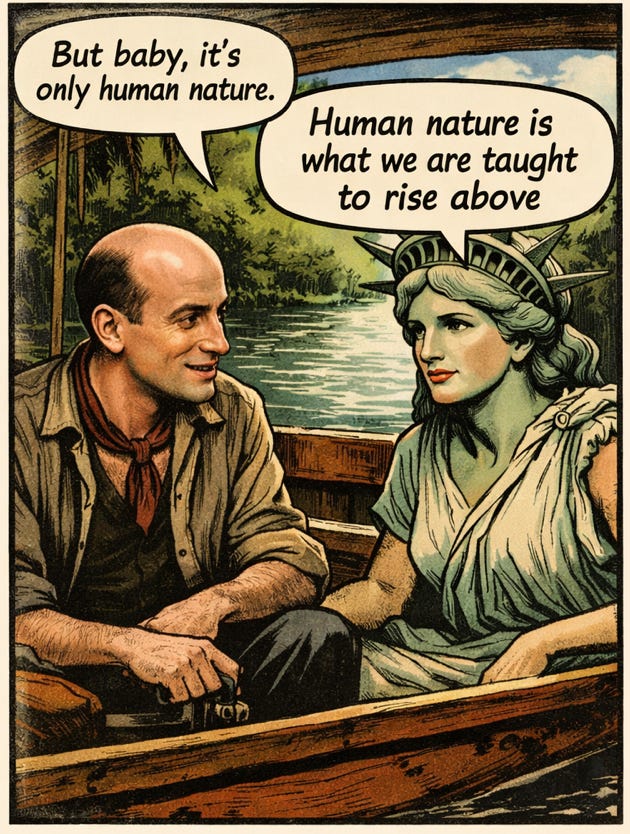
[concept, Adam Garfinkle; AI-aided art, Claire Berlinski]
Were the Patriarchs and the Hebrew Prophets and the sages after them right to insist that human agency implies moral responsibility for human acts, as individuals and as communities? And that, as a result of taking those responsibilities seriously, humankind could put itself, in partnership with the Creator, on a teleologically coherent journey to a better place in a this-earthly world?
Or has all of this been a protracted mirage? A treacherous historical trick? A massive collective idealist brainfart? A failed, absentminded meandering bound to lead back to a permanently and inescapably brutal zero-sum Hobbesian world of only winners and losers, a world where cruelty pays as a deterrent against upstart assertions of human dignity, a world of dog-eat-dog survival-of-the-fittest Spencerian realism? Donald Trump’s world, in other words.
Note that the stakes are very large here, much larger than the post-World War II arrangements that springboarded out into the world through unrivaled American power off of the United Nations and the Universal Declaration of Human Rights. Numerous writers in recent days have lamented the end of the so-called rules-based liberal international order—the so-called LIO—in Venezuela, and left it at that. They are well-meaning, to be sure, but appear to be both historically and philosophically myopic.
Who in the end will prevail in the grander and deeper argument of arguments, this debate of all debates about human social and political nature? And how will it be won, or lost?
I once thought I knew, but I am less sure now than ever before. In that regard let me remind you than Donald Trump has been indicted as a felon 34 times in recent years, each indictment based on unassailable facts. Yet Trump has managed to evade significant effects from every single one of those indictments. Let me suggest, too, that had New York City and New York State justice authorities been doing their jobs properly years ago, before Trump became a national political figure, rather than informally observing a dual system where one law applied to the super wealthy and another to everyone else, there would have been earlier well-founded indictments that a less powerful Trump might not have been able to dance around.
But here we are, and with every successful demonstration of his power—whether repeatedly diddling the law here at home or invading neighboring countries—that spites the Abrahamic/phenomenologist conviction about the essential character of human nature, Donald Trump shows the world that such “moralist garbage” doesn’t stand a chance. He adduces evidence after evidence that life is, as Jonathan Swift parodied it in A Tale of Tub, all about a world with only “knaves and fools”—and in such a world who wants to be the fool?
Too many Americans have given their votes to Donald Trump. Now the danger is that too many, whether they voted for him or not, will have forfeited their hearts and souls as well as he twists the normative environment the American Founders inherited and cherished into a disfigured wreck of its former, more noble and hopeful self. The longer he remains President, and a respected figure to so many merely by dint of his office’s aura, the greater the possibly irreparable damage he will do not just to the country, to the nation, and to the state, but to the hearts and minds of the better angels who live not only here in the United States, but everywhere that the American example of an ongoing and on balance successful experiment in liberty, equality, and brotherhood has shined. Seen by itself what happened on Friday and Saturday in Venezuela may seem insignificant. Seen as part of a broader pattern it is anything but.
***
And here, a bonus for you, dear TRP readers, the lyrics from Hamilton Camp’s 1964 song “The Pride of Man.” You’ll see right away the reason for this descant to my essay.
Turn around, go back down
Back the way you came
Can’t you see that flash of fire
Ten times brighter than the day?
And behold the mighty city
Broken in the dust again
Oh God, the pride of man
Broken in the dust again
Turn around, go back down
Back the way you came
Babylon is laid to waste
Egypt’s buried in her shame
Their mighty men are beaten down
The kings are fallen in the way
Oh God, the pride of man
Broken in the dust again
Turn around, go back down
Back the way you came
Terror is on every side
Though the leaders are dismayed
Those who put their faith in fire
In fire their faith shall be repaid
Oh God, the pride of man
Broken in the dust again
Turn around, go back down
Back the way you came
Shout a warning to the nations
That the sword of God is raised
On Babylon that mighty city
Rich in treasure wide in fame
It shall cause thy towers to fall
And make it be a pyre of flame
Oh God, the pride of man
Broken in the dust again
O Thou that dwell on many waters
Rich in treasure, wide in fame
Bow unto a god of gold
Thy pride of might shall be thy shame
Oh God, the pride of man
Broken in the dust again
And only God can lead the people
Back into the earth again
Thy holy mountain be restored
Thy mercy on thy people Lord
And here is the late and greatly missed Tony Rice performing it:
[1] Sherwin, “No, Trump Is Not ‘Transactional’,” Project Syndicate, August 6, 2025.
[2] Walzer, “On the Role of Symbolism in Political Thought,” Political Science Quarterly, June 1967. The literary equivalent of the same idea: “Any country would fall to scobs and flinders without paper. That’s all a nation is. Paper. Otherwise it’s all just land left to its own devices.” Charles Frazier, Thirteen Moons (Random House, 2007), p. 344.